Types of Fabric Pattern Repeats for Textile Printing

Carina Silk Editorial Team writes practical guides on silk fabrics, scarves and custom textile development, with a focus on materials, artwork, sampling, construction and finishing decisions.
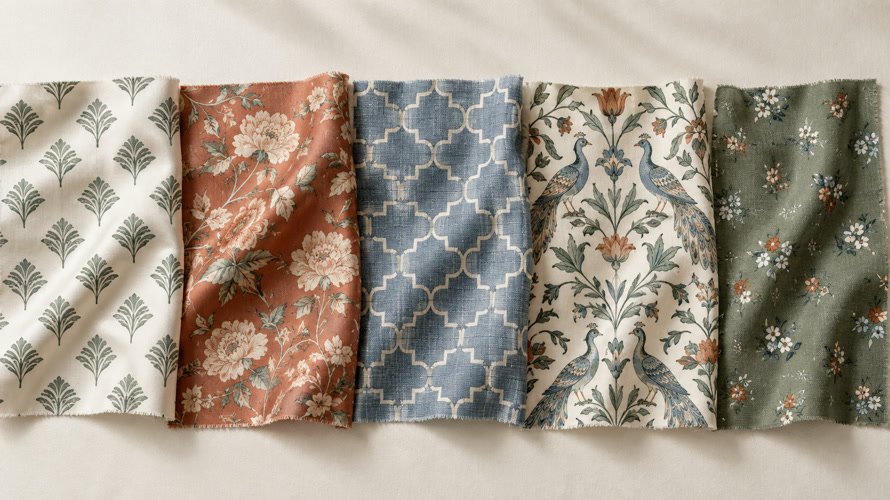
A fabric pattern repeat is the planned unit and distance by which a motif returns across the cloth. The main repeat systems include straight, half-drop, brick, mirror and tossed layouts. They create different visual rhythms, and they can change how a design behaves when it reaches a scarf border, seam, fold or finished panel.
For a custom textile brief, the repeat name is only the starting point. You should also state the motif scale, repeat dimensions, direction, usable width, base fabric, colour reference and whether the artwork is all-over, bordered or placed. This guide explains the common layouts first, then connects them to printing and sampling decisions.
What Is a Pattern Repeat in Fabric?
A pattern repeat is the unit of artwork or construction that returns across a fabric surface. It may contain one motif, a group of motifs, a stripe block, a geometric field or a complete illustrated scene. The repeat distance is measured between identical points, not merely between shapes that look similar.
The design repeat and the motif scale are related but not identical. A small flower can sit inside a large repeat, while a large flower can be arranged in a compact repeat. If these two ideas are mixed together, a digital proof can appear correct while the production fabric feels too busy, too empty or visibly mechanical.
The repeat can be printed onto the surface or formed through yarn and weave construction. For an overview of motif families, see the fabric patterns guide. For repeat terminology beyond the core systems below, a textile repeat reference provides useful comparative vocabulary.
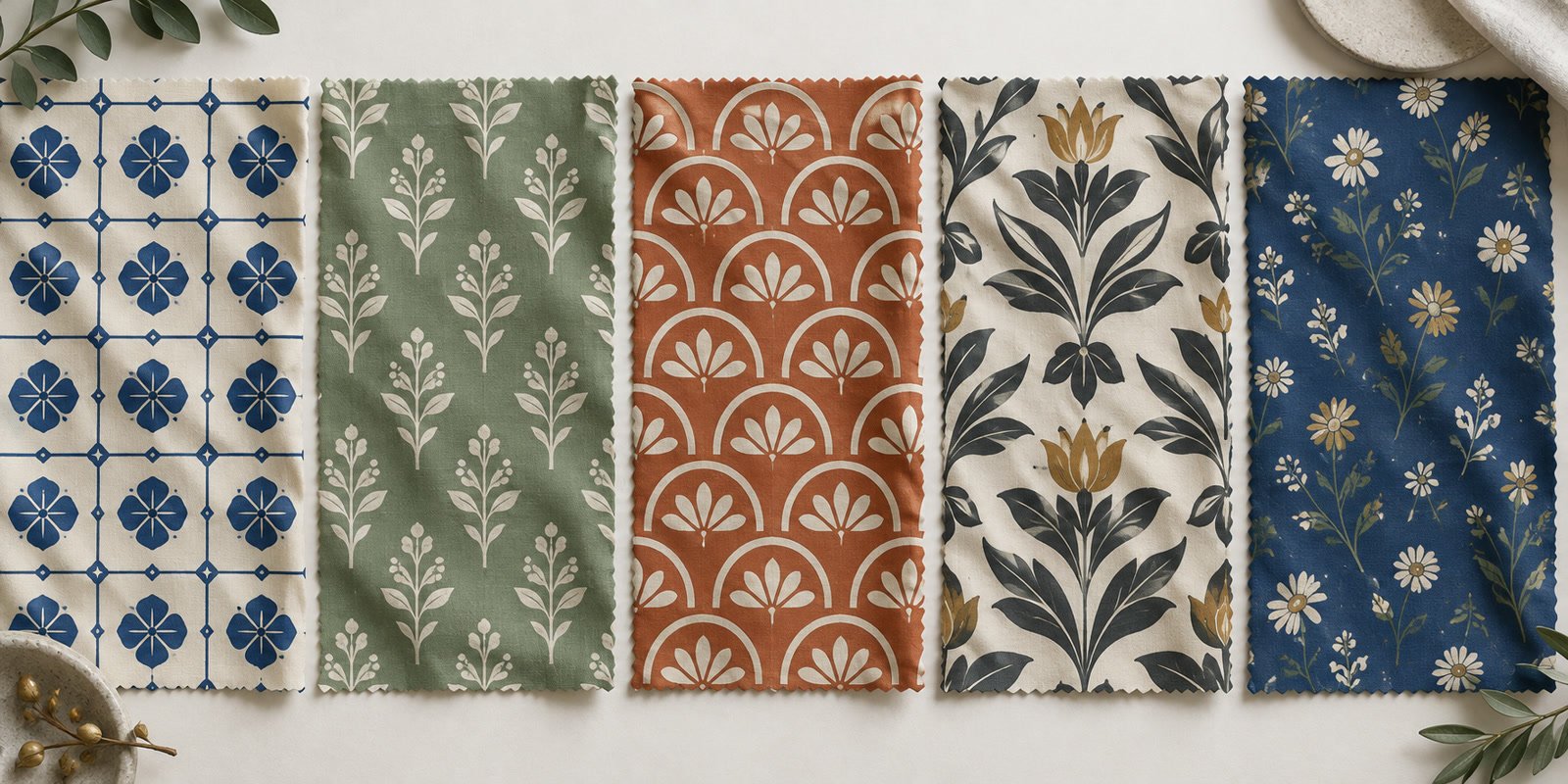
5 Common Types of Fabric Pattern Repeats
The following five layouts cover many of the repeat decisions encountered in printed fabric and surface-pattern briefs. They are not the only possible arrangements, and one finished design can combine more than one logic.
1. Straight or Block Repeat
A straight repeat places each tile directly beside and above the previous tile. The design forms a clear grid, so it works well when order, alignment and predictability are part of the visual direction. Checks, stripes, polka dots and structured geometrics often suit this arrangement.
The limitation is that the grid can become obvious, especially with organic motifs. A repeated flower with identical horizontal and vertical alignment may look more mechanical than the original artwork. Ask for a tiled proof and inspect whether the eye is drawn to the tile boundary rather than the motif.
2. Half-Drop Repeat
A half-drop repeat offsets every other column by half the tile height. The stagger breaks the straight vertical alignment and usually gives florals, leaves and other organic motifs a more continuous flow.
It is a flexible option, but the result still depends on the motif, scale and product. A half-drop can create a diagonal rhythm that fights a formal border or a highly symmetrical scarf centre. Confirm which direction the drop runs and how the repeat meets the finished edge.
3. Brick Repeat
A brick repeat shifts every other row sideways by half the tile width. It is the horizontal counterpart to a half-drop layout and can suit wide motifs, landscape illustrations or designs that need lateral movement rather than a strong diagonal.
On a long scarf, the horizontal shift may interact with the lengthwise direction and fold lines. The buyer should review the pattern on the actual scarf orientation instead of judging it only on a square tile.
4. Mirror or Reflected Repeat
A mirror repeat flips alternating tiles along one or both axes. Motifs meet their reflections, which creates bilateral symmetry and a more formal, ornamental result. Damask-style, medallion and heritage-inspired designs may benefit from this logic.
Reflection is not automatically suitable for every drawing. Letterforms, directional figures and asymmetrical botanical motifs can become confusing when reversed. If the artwork contains a logo, readable wording or a strong top-and-bottom direction, specify which elements may be mirrored and which must remain upright.
5. Tossed or Random Repeat
A tossed repeat distributes motifs with varied positions and orientations so the surface feels less tied to a visible grid. It is useful for conversational prints, small novelty motifs and organic artwork that should feel relaxed rather than engineered.
The challenge is controlled irregularity. Too much clustering creates empty areas and obvious patches, while too much regularity makes the layout look like a disguised grid. A full repeat preview helps the buyer check coverage, motif spacing and accidental seams before the file is released.
How Do Repeat Types Change Fabric Production?
Repeat choice affects more than appearance. It interacts with the base fabric, print route, usable width, cutting direction and finished dimensions. A pattern can be technically seamless as a tile but still be unsuitable for a narrow scarf, a border or a garment panel.
Repeat distance is not the same as motif size
The repeat distance describes when the design starts again. Motif scale describes how large the flower, stripe, dot or geometric element appears inside that repeat. Record both in the brief. A buyer who asks only for a “large floral” has not yet defined whether the tile is large, whether the flowers are large, or both.
Direction and usable width matter
Directional motifs need an agreed top, bottom and fabric grain. A half-drop may be visually attractive across running yardage but may not place the focal point where it is needed on a square scarf. Borders also need enough usable width for the design to remain clear after hemming or cutting.
Print and woven routes can use the same repeat vocabulary
Straight, half-drop or mirror describe arrangement, not necessarily manufacturing method. The same visual repeat can be printed on silk, built with yarns or developed as a jacquard structure. A printed reference therefore does not prove that the woven version will have the same hand feel, reversibility or surface relief.
Which Repeat Fits a Custom Scarf?
Start with the finished shape rather than choosing a repeat in isolation. A square scarf can support a centre motif with a framed border. A long scarf may suit a lengthwise stripe, a repeated logo, a narrow border or a directional field. A twilly or bandana can require more precise edge and corner planning because less fabric is available for the artwork to unfold.
| Repeat or layout | Best-fit condition | Main limitation | What to confirm |
|---|---|---|---|
| Straight/block | Structured geometrics, checks and visible order | Grid alignment can look mechanical | Tile size, alignment and finished orientation |
| Half-drop | Florals and organic motifs that need flowing movement | Offset may conflict with a formal border | Drop direction, motif scale and edge behaviour |
| Brick | Wide or horizontal motifs | Horizontal rhythm may fight a long product layout | Row offset and scarf direction |
| Mirror | Formal, ornamental or symmetrical artwork | Directional elements may reverse incorrectly | Allowed mirrored elements and upright details |
| Tossed/random | Relaxed, conversational or novelty prints | Uneven density can create gaps or clusters | Full repeat coverage and motif spacing |
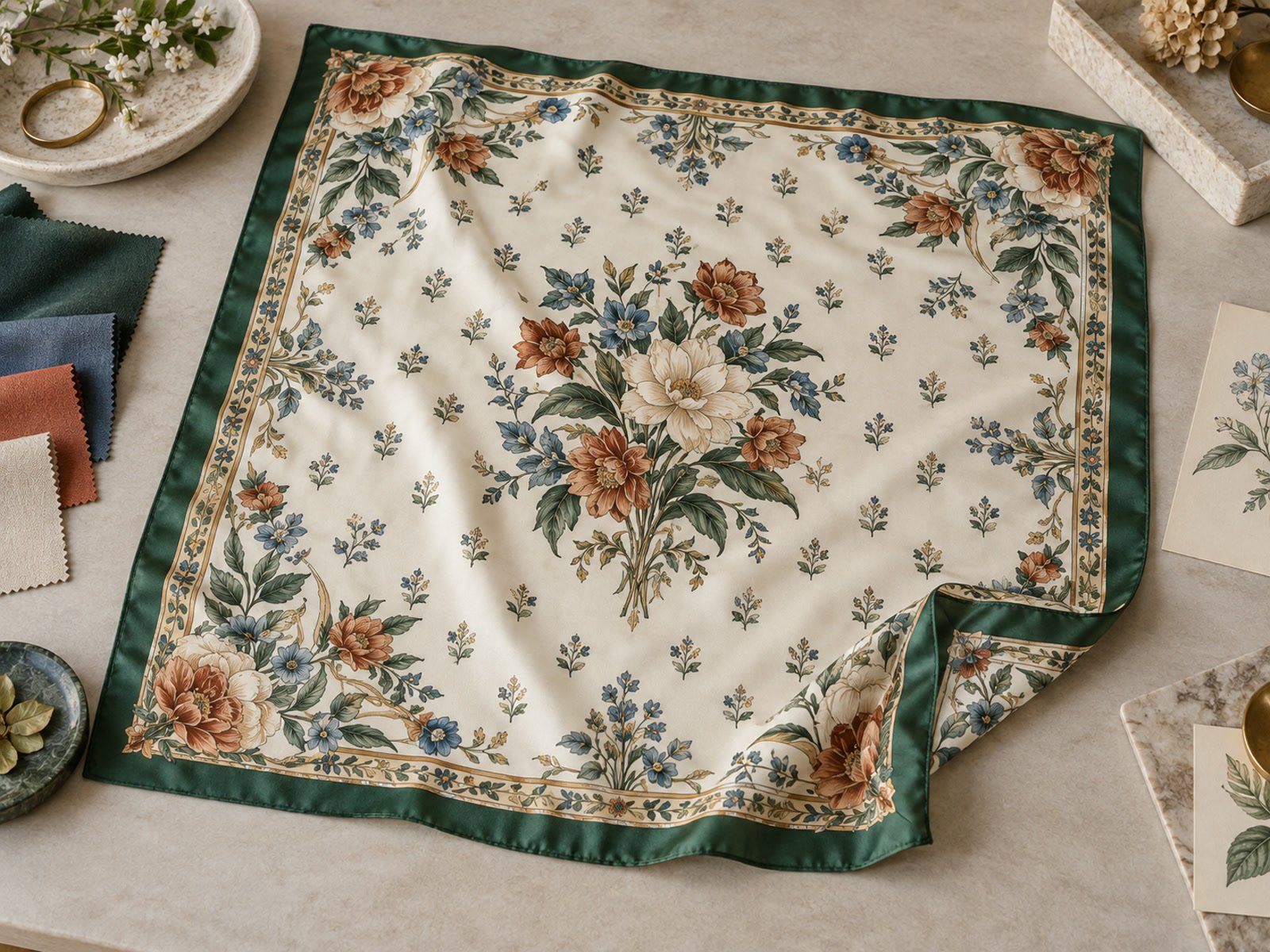
For a printed scarf, move from the repeat decision to the digital printed scarves brief with the finished dimensions, artwork orientation, colour references and edge direction included. The page destination is not a promise that one repeat will suit every fabric; it is the next place to align the pattern with the scarf format and sample process.
How Should You Approve a Repeat Before Printing?
1. Check the artwork file
Confirm the required inputs: repeat type, tile dimensions, motif scale, direction, colour references, bleed and safe area. Open the artwork as a tiled preview rather than viewing only one tile. Check the left-to-right and top-to-bottom edges for visible seams or abrupt changes.
2. Check the swatch or strike-off
A digital screen cannot validate the final fabric surface, drape or colour response. Review the repeat on the selected base fabric and at a useful production scale. The swatch or strike-off can reveal whether fine lines merge, whether a dark area becomes too dense, or whether the motif loses contrast on a textured surface.
3. Check the finished sample
The finished sample is where product geometry becomes visible. Inspect the repeat at the border, corners, hem, fold and any seam or panel join. For a scarf, confirm that the main motif remains legible when the product is folded or tied. Set acceptance criteria before approval and treat the approved sample as the reference for the later production handoff.
Conclusion
The right fabric pattern repeat depends on motif shape, scale, direction, finished product geometry and production route. Straight repeats offer order, half-drop and brick layouts create offset movement, mirror repeats add symmetry, and tossed repeats create a more relaxed field. None is universally best.
Specify the repeat together with the actual fabric, usable width, finished dimensions, colour reference and approval sequence. That turns a visual preference into a repeatable textile brief.