
Fabric Patterns: 25 Types and How to Choose the Right One

Carina Silk Editorial Team writes practical guides on silk fabrics, scarves and custom textile development, with a focus on materials, artwork, sampling, construction and finishing decisions.
- What Is a Fabric Pattern?
- How Are Fabric Patterns Made?
- 25 Common Fabric Pattern Types
- How Are Pattern Scale, Repeat and Placement Different?
- Which Fabric Pattern Works for a Custom Textile?
- How Should a Buyer Prepare a Pattern for Production?
- How Can You Compare Fabric Pattern Options Without Losing Information?
- Conclusion: Treat the Pattern Name as the Starting Point
- FAQs
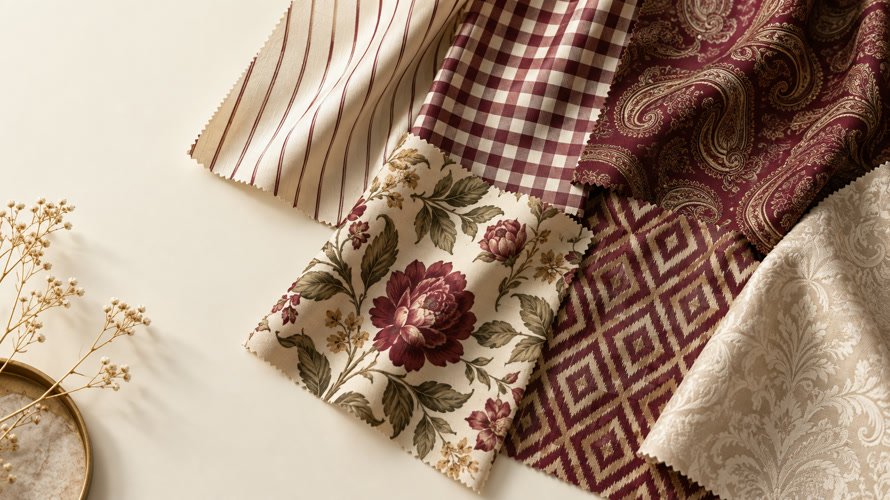
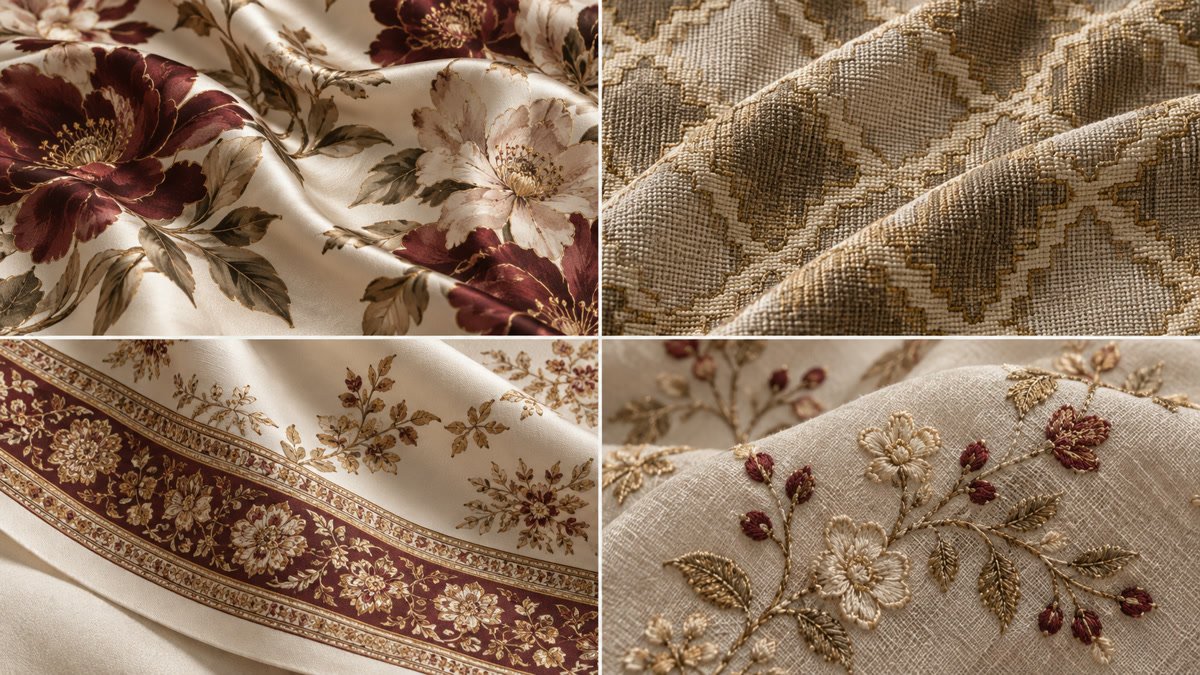
Fabric patterns are often discussed as if the visual name is the whole decision. It is not. A stripe, paisley, damask or floral can be printed on the surface, woven into the cloth, embroidered onto a base or arranged as an engineered border or panel. The same motif can therefore create a very different result depending on the construction route, fabric, scale, repeat and finished product.
This guide covers 25 common fabric patterns, including the families buyers see most often in textile searches. It then adds the production questions that a glossary usually leaves out: how pattern scale changes after cutting, when direction or matching becomes a risk, what a border or panel layout requires, and which artwork and sample checks should happen before bulk production.
What Is a Fabric Pattern?
A fabric pattern is the visible motif, structure or arrangement that gives a textile its visual identity. It may be a repeated surface design, a woven contrast created by yarns and weave, a raised embroidered motif or a deliberate placement such as a scarf border. Pattern vocabulary helps a buyer describe what the textile should look like, but it does not by itself specify the fibre, weave, weight, width, finish or printing method.
That distinction matters in sourcing. A printed damask-style design and a woven jacquard damask may share a visual reference while differing in hand feel, reversibility, texture, colour depth and sampling method. In the same way, a large floral repeat may look attractive in a digital layout but lose its focal point when cut into a narrow scarf or garment panel.
For a custom project, treat the pattern name as the starting point. The useful brief also states the end product, base fabric, finished dimensions, motif scale, repeat or placement, direction, colour reference, print or weave route and approval sample.
How Are Fabric Patterns Made?
The first production question is not “Which pattern is most popular?” It is “How should this pattern exist on the fabric?” Surface print, woven structure, jacquard, embroidery and engineered placement solve different design problems.
Surface printing
Digital, screen and other printing routes apply colour or artwork to the fabric surface. Printing supports detailed motifs, gradients, painterly artwork and custom colourways, but the result still depends on the base fabric, colour management, coverage, registration and finishing. A custom scarf brief should identify whether the artwork is a full repeat, a border, a panel or a front-and-back arrangement. For a scarf project, the digital printed scarves page is the relevant next step after the pattern direction is selected.
Woven patterns and jacquard
Woven patterns are created through the relationship between warp, weft, yarn colour and weave structure. Jacquard construction can form more complex woven-in motifs and may give the design a different surface response from a printed image. If the pattern needs to be part of the cloth rather than simply placed on top, compare a printed reference with a woven sample. Carina’s silk jacquard fabric page is the relevant destination for that direction.
Embroidery and raised decoration
Embroidery adds thread-based motifs above or through a base fabric. It can be useful when the pattern needs tactile relief, a handcrafted appearance or a selective decorative detail. The buyer should confirm stitch density, backing, placement, edge behaviour and how the finished product will be folded or washed. An embroidered floral and a floral print may share the same drawing but should not be quoted as the same construction.
Engineered borders and panel layouts
An engineered layout is designed for a specific finished shape rather than repeated evenly across unlimited yardage. Borders, corner motifs, centre panels and placement artwork are common examples for scarves, bandanas, labels and decorative panels. The artwork should be checked against the finished dimensions, usable width, seam or hemming allowance and cutting orientation before a sample is approved.
25 Common Fabric Pattern Types
The following list keeps the 25 pattern families a buyer is likely to meet in a general fabric-pattern search. The descriptions focus on what the motif looks like, where it is commonly used and what to check when it moves into a custom textile brief.
Classic checks and linear patterns
1. Stripe
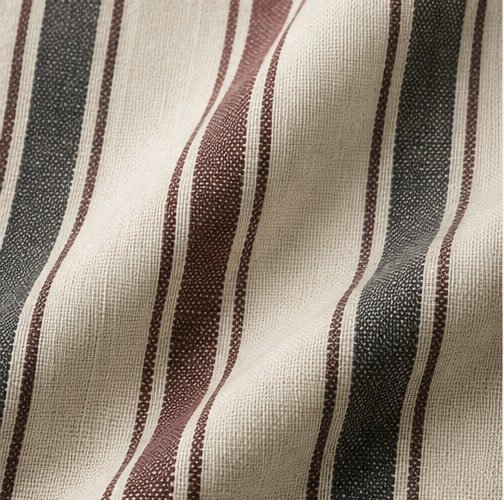
Stripes use parallel lines that vary in width, spacing, colour and direction. They may run vertically, horizontally or diagonally, and they can be printed or formed through yarn arrangement. For scarves and garments, confirm the direction and whether the stripes must align at seams or edges.
2. Chevron
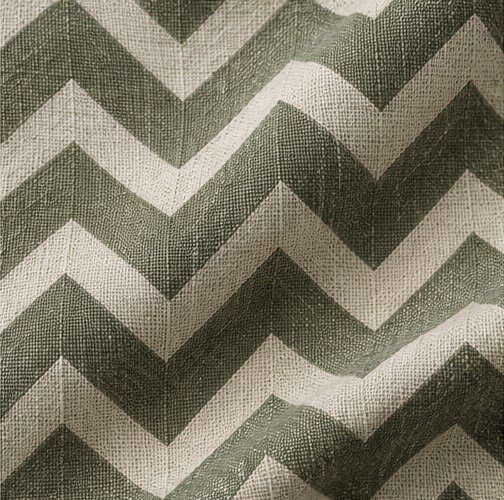
Chevron is a continuous zigzag made from connected V shapes. It creates more uninterrupted movement than a broken herringbone and can read strongly on a border or narrow panel. Confirm the repeat width and the direction of the V shapes before cutting.
3. Herringbone
Herringbone creates a broken V or fish-bone effect, often through alternating diagonal structures. It is associated with tailored, structured and heritage textiles, but a similar look can also be printed. Ask whether the reference is a woven construction or a surface design because the texture will not be identical.

4. Polka dot
Polka dots are repeated circles that can range from tiny pin dots to large statement spots. Their non-directional quality is often forgiving for cutting, while changes in dot scale can move the result from formal to playful. Confirm the finished dot diameter rather than approving only a screen preview.
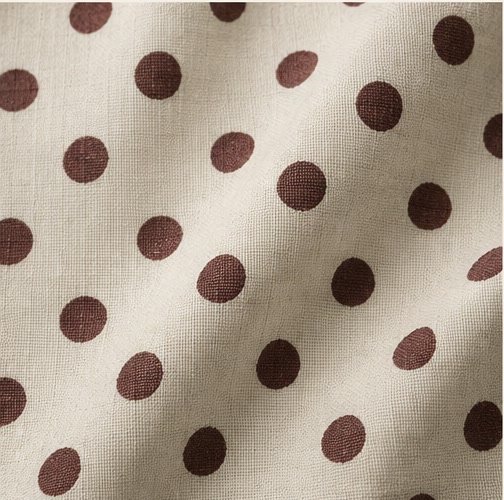
5. Check
Check is a broad family of intersecting horizontal and vertical lines or blocks. It includes simple two-colour checks as well as more complex plaid structures. The main buyer risk is alignment: check size, usable width and seam placement should be reviewed together.
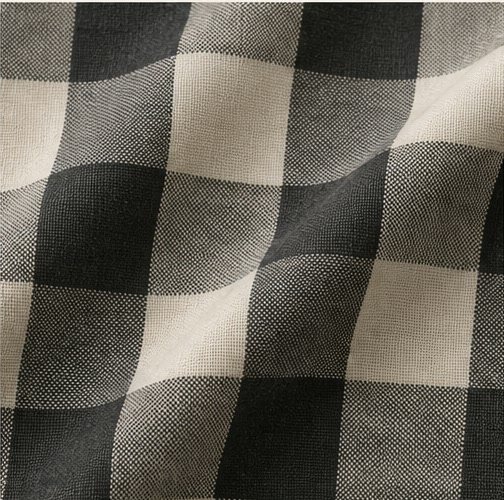
6. Gingham
Gingham is usually recognized by evenly spaced stripes crossing to create a regular two-colour check. It has a clean, approachable appearance and is used in apparel, accessories and home textiles. Confirm whether the design should remain square after finishing and whether the fabric width permits the intended scale.

7. Tartan plaid
Tartan is a layered plaid with multiple stripe widths and colour crossings, often associated with Scottish textile traditions. The visual identity depends on the sett, or repeat arrangement, so the repeat must be supplied clearly. A buyer should approve the repeat at finished size before cutting or matching panels.

8. Glen plaid
Glen plaid combines small checks and overchecks into a more complex tailored pattern. It is often used for suiting, jackets, trousers and accessories. Fine lines can disappear or merge on a low-resolution artwork proof, so inspect the production-scale sample rather than relying on a compressed image.

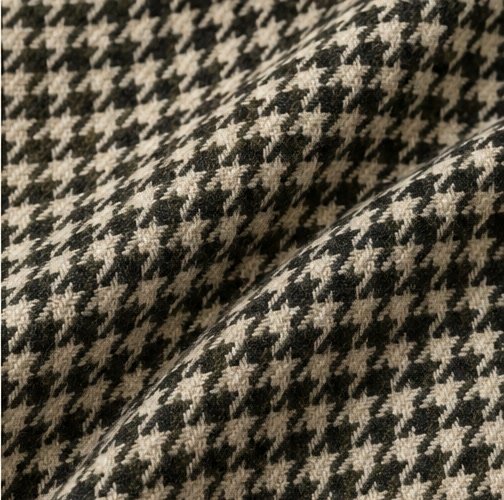
9. Houndstooth
Houndstooth is a broken check built from interlocking, four-pointed shapes, commonly in contrasting colours. It creates a strong graphic effect and is often used in tailored fashion and accessories. Check the scale, contrast and edge behaviour because a large houndstooth can dominate a small scarf.
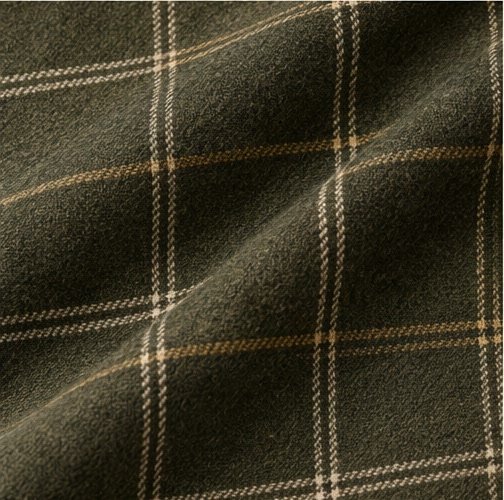
10. Windowpane plaid
Windowpane plaid uses widely spaced lines that create large open rectangles. It feels lighter and less dense than a compact check, but its geometry is highly visible when the fabric is folded or cut. Confirm line thickness, rectangle proportion and direction on the finished product mock-up.
11. Harlequin
Harlequin uses repeated diamonds, often in alternating colours or tonal contrasts. It can create a theatrical, graphic or costume-oriented effect, but a muted palette can also make it more refined. Confirm diamond orientation and border interaction when the pattern is used on a square scarf.

12. Argyle plaid
Argyle combines overlapping diamonds, usually with diagonal lines or small accent motifs. It is strongly associated with knitwear, accessories and preppy styling, although the design can be printed on woven fabric. Review the diagonal repeat and allow for matching if multiple pieces will sit side by side.

Floral and natural motifs
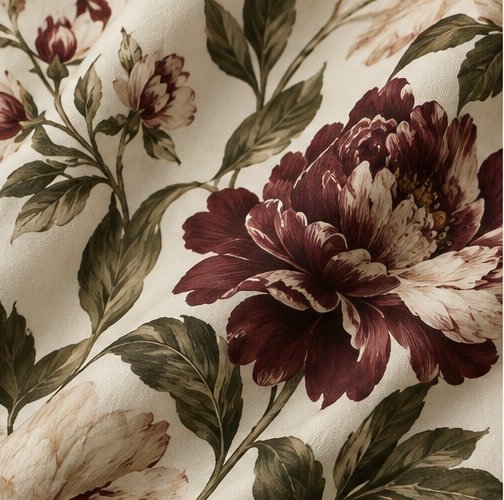
13. Floral
Floral patterns depict flowers and may be realistic, stylized, painterly or abstract. They are versatile across scarves, garments, bedding and decorative textiles, but their scale changes the product impression quickly. Confirm whether the artwork is intended as a scattered repeat, a large placement or a framed border.
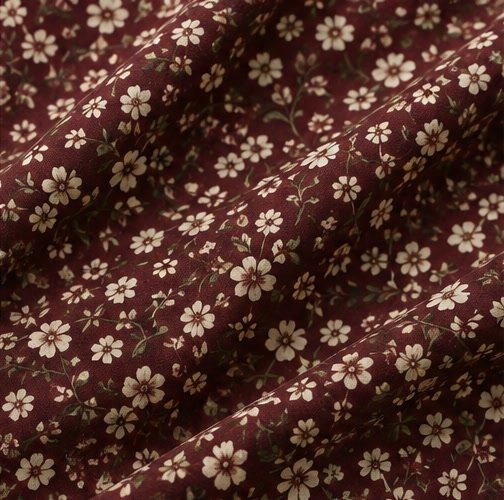
14. Ditsy floral
Ditsy floral uses small, repeated flowers distributed densely or loosely across the surface. At a distance it can read like texture, which makes it useful for apparel, accessories and smaller products. The buyer should confirm motif size, density and whether the flowers need a controlled direction.
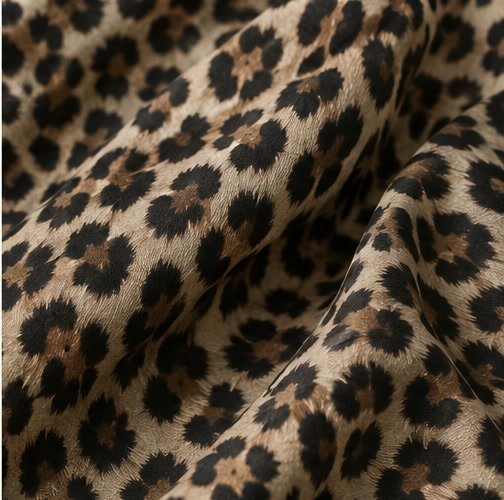
15. Leopard
Leopard patterns use spots or rosettes inspired by an animal coat. They are usually high-contrast and visually assertive, so colourway and scale are important decisions. Ask whether the design is a faithful animal reference, a stylized fashion interpretation or a placement print, and approve the repeat accordingly.
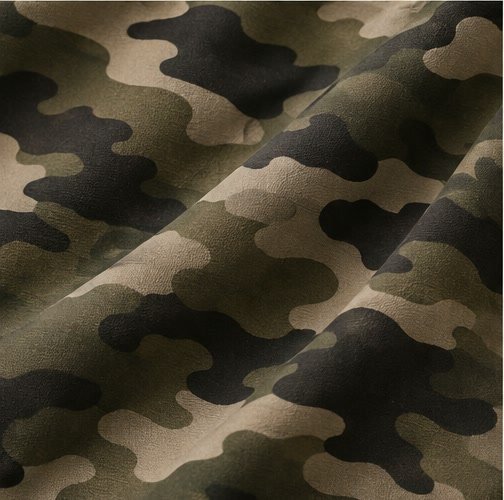
16. Camouflage
Camouflage patterns use irregular patches or organic shapes that break up the surface. They can be literal, fashion-led, tonal or abstract. Because the motif is irregular, a repeat tile should be checked for obvious seams or repeated clusters, especially on large fabric panels.
Decorative and heritage motifs
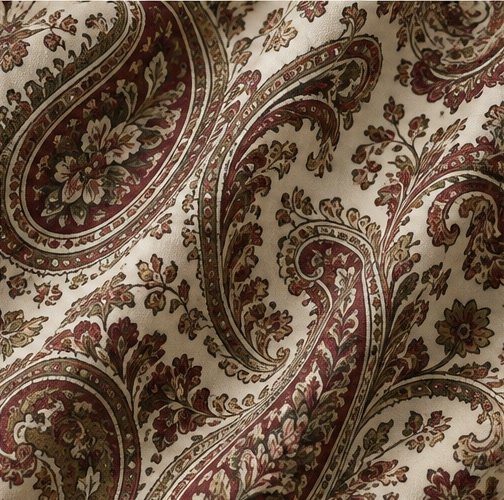
17. Paisley
Paisley is recognized by a curved teardrop or boteh-like motif that can be arranged in dense repeats, borders or large statement placements. It is common in scarves, ties, bandanas and decorative textiles. Confirm the direction of the teardrop, the scale of the inner detail and how the border will frame the finished product.
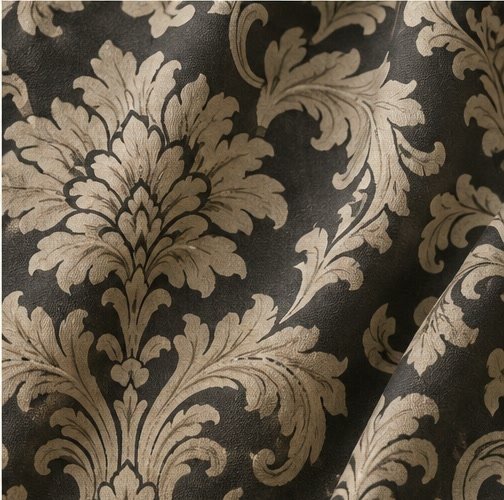
18. Damask
Damask typically uses formal botanical, scroll or medallion motifs in a structured arrangement. It may be woven with contrasting structures, printed as a tonal surface design or developed as a hybrid look. Ask specifically whether the desired result is woven jacquard or printed artwork; the visual similarity does not make the specifications interchangeable.
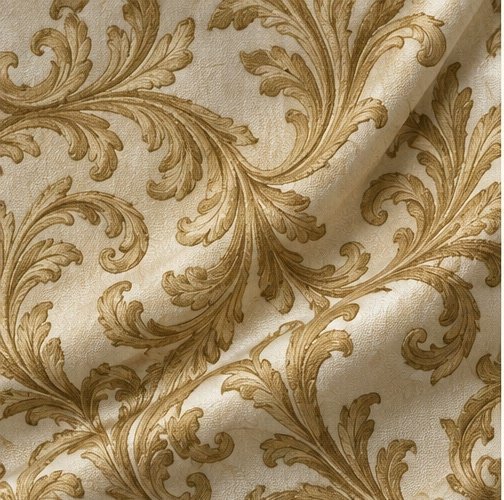
19. Baroque
Baroque patterns use ornate scrolls, foliage, medallions and strong decorative movement. They suit statement fashion, accessories and interiors when the surface can carry detail. For a scarf, check whether the artwork needs a centre, border or corner hierarchy so the visual weight does not disappear in folds.
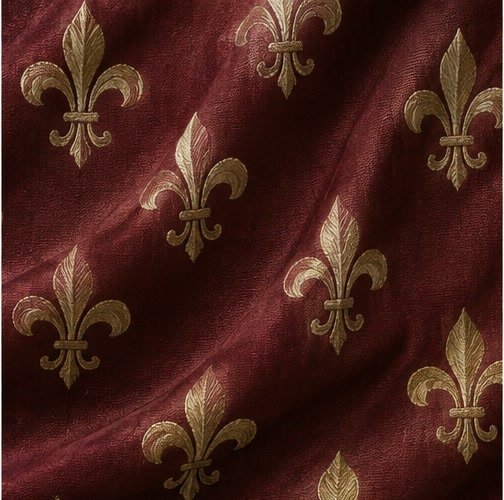
20. Fleur-de-lis
Fleur-de-lis patterns repeat a stylized three-lobed emblem, sometimes with crowns, frames or ornamental separators. They can look formal, heritage-led or graphic depending on scale and colour. Confirm whether the motif must remain upright and whether the repeat needs a border-safe area.
21. Toile de Jouy
Toile de Jouy is commonly associated with a single-colour scenic or pastoral illustration on a contrasting ground. It needs enough uninterrupted surface for the scene to remain legible, which makes scale and product size important. A narrow accessory may require a simplified or cropped placement rather than a full scenic repeat.

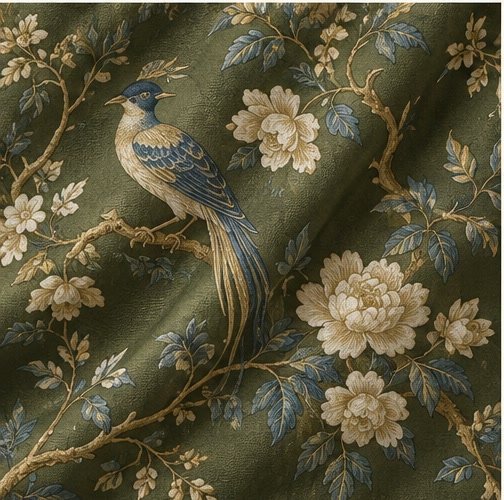
22. Chinoiserie
Chinoiserie-inspired patterns use stylized East Asian decorative references such as florals, birds, pagodas or garden scenes. The phrase describes a visual design language rather than one fixed construction method. Confirm the artwork source, cultural treatment, colourway and whether the design is intended as a repeat, border or framed panel.
23. Ikat
Ikat traditionally describes a resist-dyeing approach applied to yarns before weaving, creating characteristic softened or feathered edges. An ikat-inspired pattern can also be printed to imitate that appearance. The buyer should state whether the requirement is an actual woven/resist construction or a printed visual reference.

Geometric and structured motifs
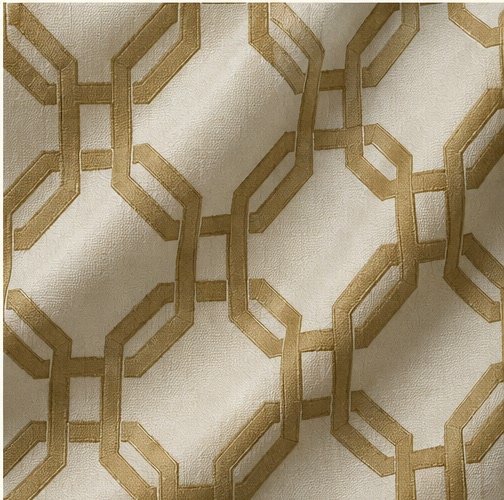
24. Geometric
Geometric patterns use shapes, grids, lines, angles or abstract symmetry rather than recognizable natural objects. They are effective for modern scarves, linings, packaging textiles and fashion panels, but alignment becomes visible quickly. Confirm repeat dimensions, direction, registration and the relationship between the pattern and the fabric width.
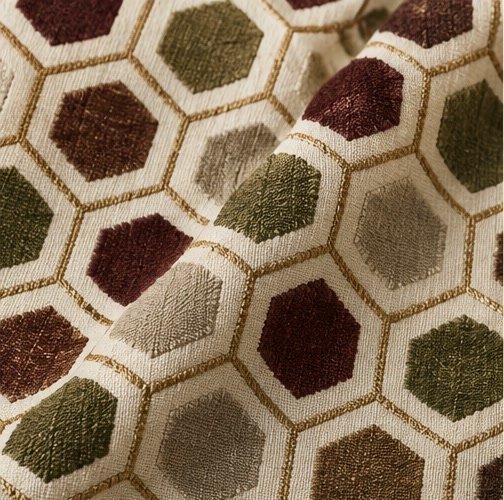
25. Honeycomb
Honeycomb patterns use repeating hexagons or cell-like structures. They may be outlined, filled, irregular, textured or combined with a secondary motif. Because the grid is regular, small registration or distortion can be noticeable; approve a full repeat and inspect it on the actual base fabric.
How Are Pattern Scale, Repeat and Placement Different?
Pattern scale is the physical size of the motif. Repeat is the interval at which the artwork starts again. Placement describes where the artwork is intended to sit on the finished item. These are related, but they are not interchangeable.
A small ditsy floral can behave like a surface texture, while an oversized botanical may need a wide, uninterrupted panel. A straight repeat is orderly; a half-drop or brick arrangement can distribute organic motifs more naturally; a border repeat may be designed to run along a scarf edge rather than across the full width. None of these layouts should be approved from a thumbnail alone.
Directional patterns also change cutting decisions. Stripes, plaids, herringbone, chevron and some florals need an orientation check. Non-directional dots or scattered motifs can be more flexible, but a scattered repeat still needs to be checked for visible tile seams and uneven clustering.
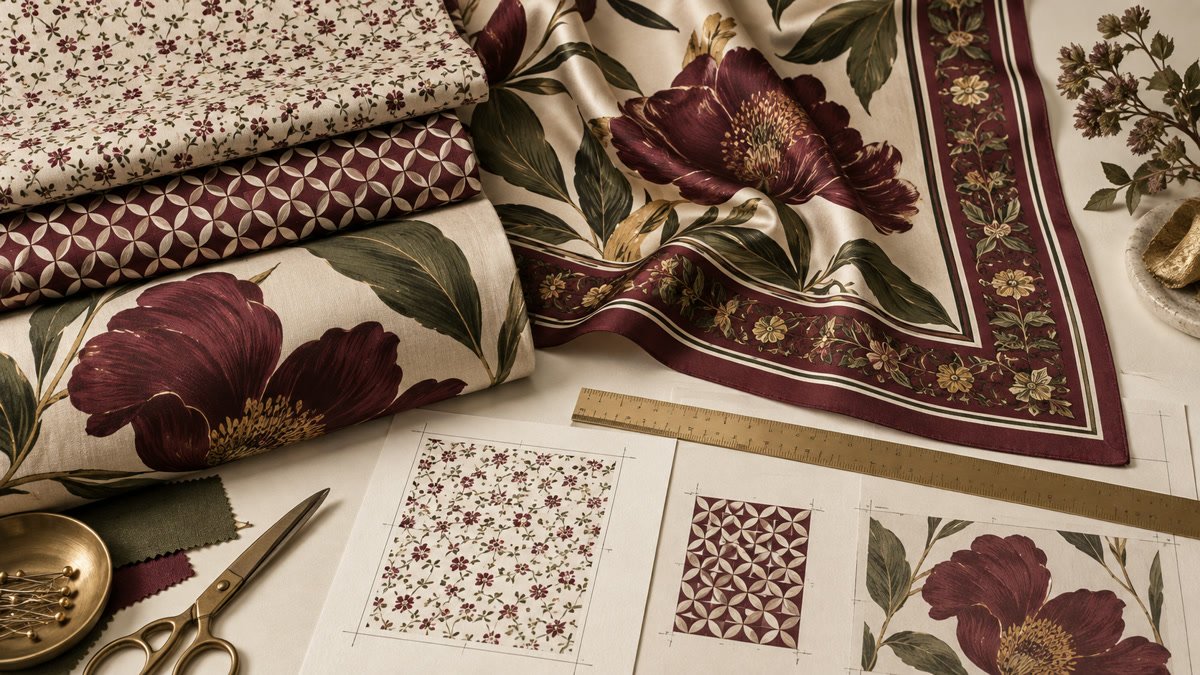
Use a finished-size proof to review:
- motif size at the actual scarf, garment or panel dimensions;
- repeat width and height, including where the tile restarts;
- border depth, corner treatment and safe area for hemming or seams;
- direction after folding, cutting or joining;
- colour contrast against the base fabric;
- placement of the focal motif in the final product.
Which Fabric Pattern Works for a Custom Textile?
There is no single best pattern. The better choice is the pattern that fits the product geometry, fabric surface, intended audience and production route. Use this decision table as a starting point before requesting a sample.
| Product or project need | Pattern directions to consider | Main risk to check | Approval evidence |
|---|---|---|---|
| Small scarf, twilly or narrow accessory | Small floral, ditsy, stripe, polka dot or compact geometric | Motif disappears, becomes crowded or loses direction after folding | Finished-size mock-up and printed swatch |
| Square scarf with a strong frame | Paisley, damask, floral, baroque, toile or border placement | Border is cut unevenly or the centre loses hierarchy | Full-size placement proof with corner and hem allowance |
| Tailored garment or structured panel | Glen plaid, houndstooth, herringbone, check or windowpane | Lines do not match across seams or panels | Pattern repeat, usable-width plan and joined sample |
| Fluid apparel or home textile | Floral, abstract, geometric, ikat-inspired or tonal damask | Scale feels wrong on drape and large uninterrupted areas | Base-fabric swatch plus draped printed sample |
| Woven-in texture or reversible effect | Damask, herringbone, geometric or jacquard motif | Printed reference is mistaken for woven construction | Woven jacquard sample and construction specification |
| Brand or artist artwork | Engineered panel, placement floral, geometric or custom repeat | Artwork is cropped, distorted or colour-shifted in production | Artwork proof, colour reference and strike-off |
For a printed viscose direction, the printed viscose fabric page is a relevant internal reference. The next decision should still be based on the exact base construction, weight, width, artwork and sample rather than on the pattern name alone.
How Should a Buyer Prepare a Pattern for Production?
Before sending artwork, decide whether the supplier is receiving a seamless repeat, a border, a panel or a complete product layout. The required inputs are the finished dimensions, motif scale, repeat or placement, colour reference, base fabric and print route. Then provide the information that allows the design to be evaluated at the right scale.
Confirm the artwork geometry
State the finished product size, repeat dimensions, orientation, border width, placement area and any bleed or safe area. If the artwork is intended for a scarf, include the centre, border and corner logic rather than sending only a cropped motif.
Confirm the colour direction
Provide a colour reference or agreed colourway and explain which colours are fixed and which can be adjusted. A screen image is useful for direction but cannot validate final printed colour, coverage or registration; it cannot replace a printed strike-off when colour approval is important.
Confirm the base fabric and route
State the fibre direction, construction, weight, usable width, surface finish and intended print or weave route. Pattern density and fine detail can behave differently on a smooth satin, a textured crepe, a twill or a woven jacquard. The base fabric is part of the pattern decision, not a separate afterthought.
Confirm the sample sequence
Use a simple staged review:
- Approve the motif, repeat or placement at finished size.
- Review the base-fabric swatch for surface, handle, weight and drape.
- Review the strike-off for colour, coverage, detail, registration and repeat.
- Review the finished sample for dimensions, direction, border, seams and edge finish.
- Record the acceptance criteria and approved reference before bulk production.
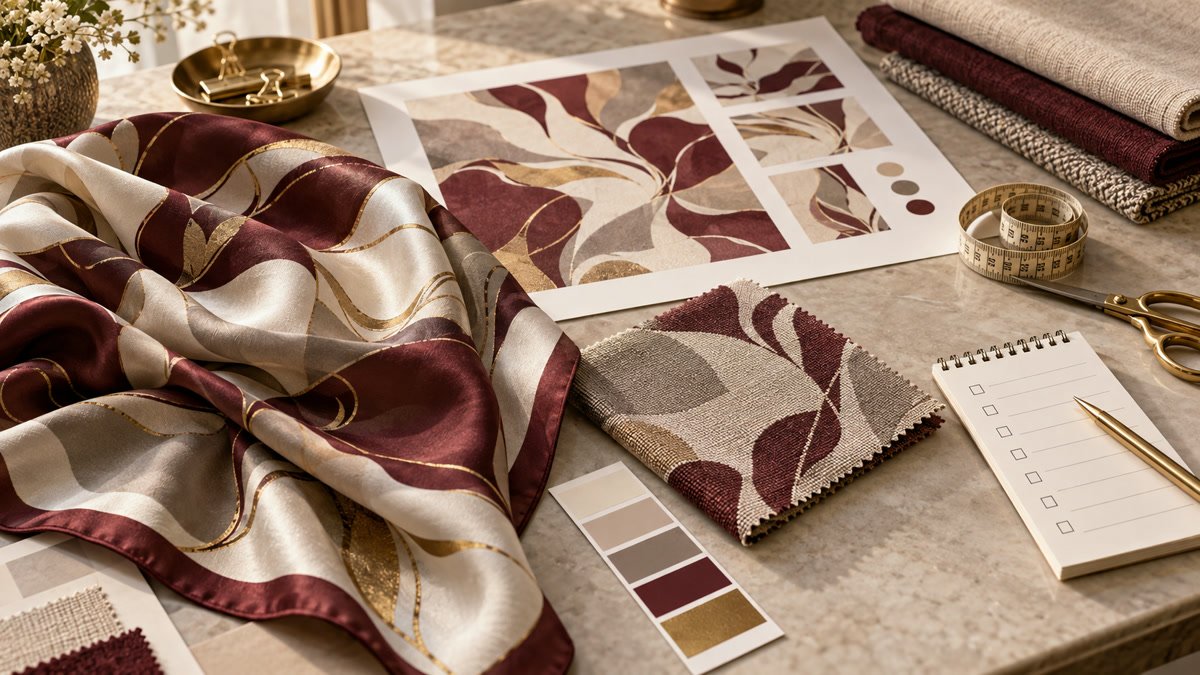
This sequence is especially useful when a pattern is being developed for a custom scarf. Carina Silk’s digital printing scarf page covers the related artwork, format, fabric, finishing and sample-review considerations.
How Can You Compare Fabric Pattern Options Without Losing Information?
When several patterns look acceptable, compare them using the same specification rather than choosing from screenshots. Record the motif family, construction route, scale, repeat, direction, colour count, base fabric, finished product, usable width and sample status in one brief.
The most useful comparison is not “Which pattern looks nicer?” It is:
- Does the motif remain legible at finished size?
- Does the repeat fit the product geometry and usable width?
- Will direction or matching add cutting risk?
- Does the pattern require a printed surface, a woven structure or an engineered placement?
- Does the colour contrast suit the base fabric and final use?
- Has the actual sample been checked for registration, drape, edge treatment and dimensions?
If the answer to those questions is clear, the pattern name becomes useful shorthand instead of an incomplete specification.
Conclusion: Treat the Pattern Name as the Starting Point
Fabric patterns give buyers a shared visual vocabulary, but the name is only the first decision. The finished result depends on whether the design is printed, woven, embroidered or engineered; how large the motif is; how the repeat is built; how the artwork is positioned; and how the base fabric behaves after finishing.
For custom textiles, shortlist the pattern family first, then confirm scale, repeat, direction, colour, usable width, construction route and finished-product geometry. Approve a swatch, strike-off and finished sample before treating the pattern as production-ready.
FAQs
What are the most common fabric patterns?
Common fabric patterns include stripes, chevron, herringbone, polka dots, checks, gingham, tartan, Glen plaid, houndstooth, windowpane, harlequin, argyle, floral, ditsy floral, leopard, camouflage, paisley, damask, baroque, fleur-de-lis, toile de Jouy, chinoiserie, ikat, geometric and honeycomb patterns.
What is the difference between a fabric pattern and a fabric print?
A fabric pattern describes the visible motif or arrangement. A fabric print is one way to apply that pattern to the surface. The same visual pattern may also be woven, formed through jacquard, embroidered or engineered as a placement.
Which fabric patterns work best for scarves?
Small florals, ditsy motifs, stripes, polka dots, paisley, geometric patterns and border layouts can all work for scarves. The right choice depends on the finished size, fold direction, base fabric, motif scale, border treatment and whether the design is a repeat or an engineered placement.
What is a repeat pattern in textile design?
A repeat pattern is artwork arranged so that a tile or layout starts again at a defined interval. Straight, half-drop, brick, scattered and border repeats distribute motifs differently. Approve the repeat at finished size so seams, edges and clustering can be evaluated.
How should I prepare a fabric pattern for custom printing?
Provide the finished product size, motif scale, repeat or placement, direction, border and safe area, colour references, base-fabric direction, usable width and desired edge finish. Review a base-fabric swatch, strike-off and finished sample before bulk approval.
Is a jacquard fabric pattern printed?
Not necessarily. Jacquard patterns are commonly created through woven structure, while a similar-looking motif may also be printed. Ask which route is required and approve a sample that shows the actual texture, colour response and reversibility expected for the finished product.
