
What Is Woven Fabric? Structure, Types, Uses and Buyer Checks

Carina Silk Editorial Team writes practical guides on silk fabrics, scarves and custom textile development, with a focus on materials, artwork, sampling, construction and finishing decisions.
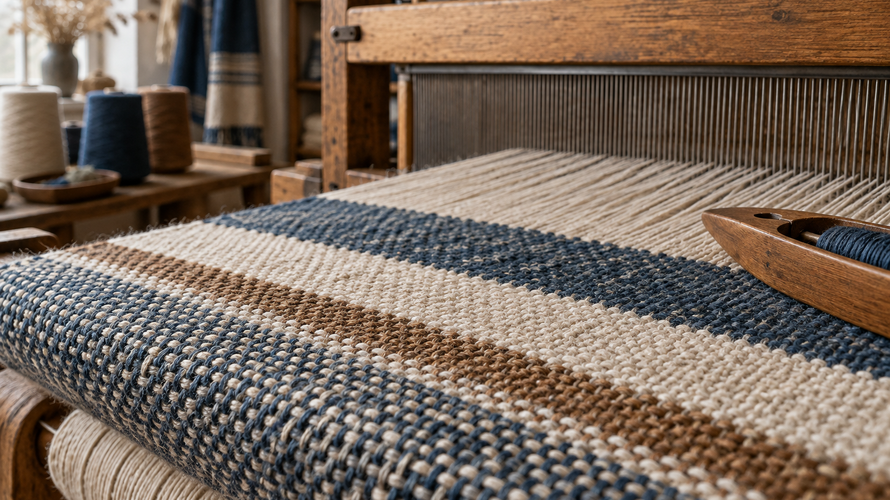
To answer the question what is woven fabric: it is a textile made by interlacing two yarn systems, called the warp and the weft, on a loom. The crossing structure gives the fabric its construction; the fibre may be cotton, silk, wool, linen, polyester, viscose, or a blend.
That distinction matters when you are developing scarves, apparel, home textiles, or another custom product. A fibre name does not tell you whether the fabric is woven, knitted, or nonwoven, and a weave name does not tell you the exact weight, finish, opacity, or finished-product behaviour. Buyers need all of those layers in the specification.
What Is Woven Fabric?
Woven fabric is formed when one set of yarns runs lengthwise as the warp and another set crosses it as the weft. The loom holds the warp under controlled tension and inserts the weft through the opening between warp yarns. The repeated interlacing creates a stable fabric surface and a recognisable grain direction.
CottonWorks’ weaving overview describes this warp-and-weft construction and the preparation steps that support it. The exact appearance and performance still depend on yarn size, yarn spacing, weave draft, finishing, and the fibre used.
Warp and weft: the two yarn directions
Warp yarns normally run in the length direction of the fabric and are prepared to tolerate loom tension. Weft yarns are inserted across the width. These directions help a buyer discuss grain, usable width, pattern placement, stretch on the bias, and how a finished panel may behave during cutting and sewing.
Warp and weft are construction directions, not a guarantee that every woven fabric will be stiff or non-stretch. A woven fabric can have mechanical give, a bias drape, an elastane component, a loose construction, or a finish that changes its movement.
Fibre, construction, and finish are different layers
- Fibre identifies the raw material family, such as silk, cotton, polyester, or viscose.
- Construction identifies how the yarns or fibres are organised, such as plain weave, twill, satin, knit, or nonwoven.
- Finish describes treatments and surface results that influence handle, lustre, softness, shrinkage, colour, and care.
For a reliable quotation or sample request, name the fibre, construction, target weight, usable width, finish, colour or artwork, and intended end use together.
How Is Woven Fabric Made?
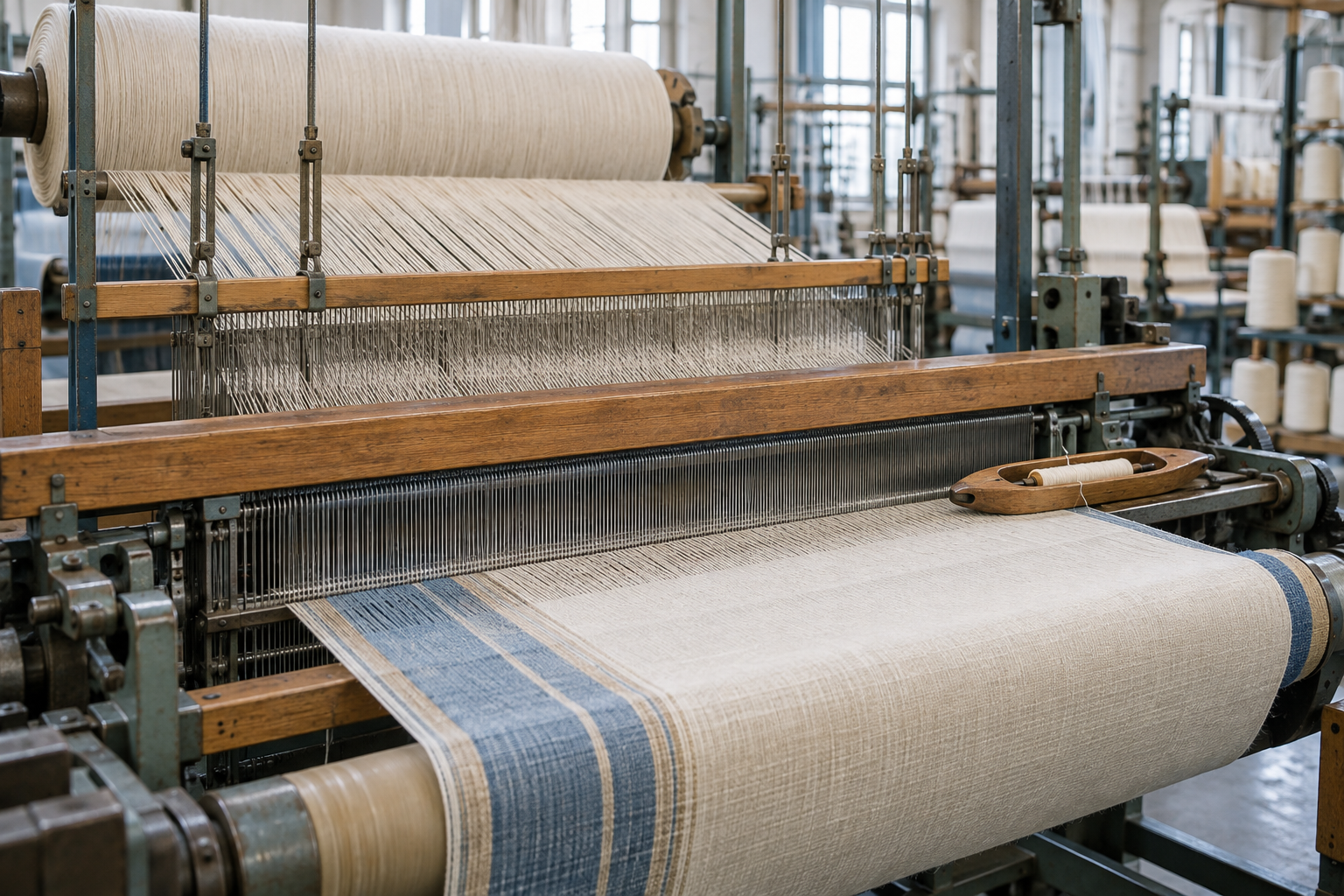
The industrial route varies by fibre and product, but the basic logic remains a sequence of preparation, interlacing, finishing, and inspection. A fabric that looks similar on a screen can perform differently if its yarns, density, finishing route, or final width changes.
Yarn and fibre preparation
Fibres are spun or supplied as yarns suitable for the intended construction. Yarn count, twist, strength, hairiness, colour, and moisture condition can influence how smoothly the yarn moves through preparation and weaving. For a buyer, this is why “100% cotton” or “100% silk” is only the start of the description.
Warping and loom setup
Warping arranges the lengthwise yarns in the required order and width. The yarns pass through heddles and a reed so the loom can open a shed, control spacing, and beat each inserted weft into position. The setup determines the draft, density, pattern, and usable fabric width.
Weft insertion and weaving
The loom raises selected warp yarns, inserts the weft, and closes the shed repeatedly. Plain, twill, satin, dobby, jacquard, and other structures use different interlacing plans. The result is not only a visual pattern; the structure also changes surface contact, float length, stability, drape, and snag risk.
Finishing and inspection
After weaving, the fabric may be washed, dyed, printed, calendered, brushed, softened, coated, heat-set, or otherwise finished. The finished width, weight, colour, hand feel, shrinkage, and edge condition should be checked on the actual production route, because finishing can change the fabric substantially.
What Are the Main Types of Woven Fabric?
The most useful way to classify woven fabric is by its weave structure. The three basic families commonly used to explain woven design are plain, twill, and satin. More complex fabrics may use dobby or jacquard mechanisms to create small or large-scale woven motifs.

Plain weave
Plain weave passes the weft over and under successive warp yarns in a simple repeat. It is a stable, familiar structure that can suit lightweight apparel, linings, cotton fabrics, silk habotai, and many other constructions. Its relatively frequent interlacing can create stability, but the final hand and drape still depend on yarns, density, weight, and finish.
Twill weave
Twill creates a diagonal line by shifting the interlacing pattern across the fabric. The structure can offer a more defined surface and drape than a comparable plain weave, which is why twill appears in many apparel, uniform, accessory, and printed-scarf applications. Confirm the direction, scale, weight, and surface before assuming that every twill will behave alike.
Satin weave
Satin uses longer floats to create a smoother, more reflective face. Satin is a weave family, not a synonym for silk: a satin fabric can use silk, polyester, acetate, or another fibre. Longer floats can give a fluid surface, but they may also need more care around snagging, abrasion, and seam handling.
Jacquard and dobby weaves
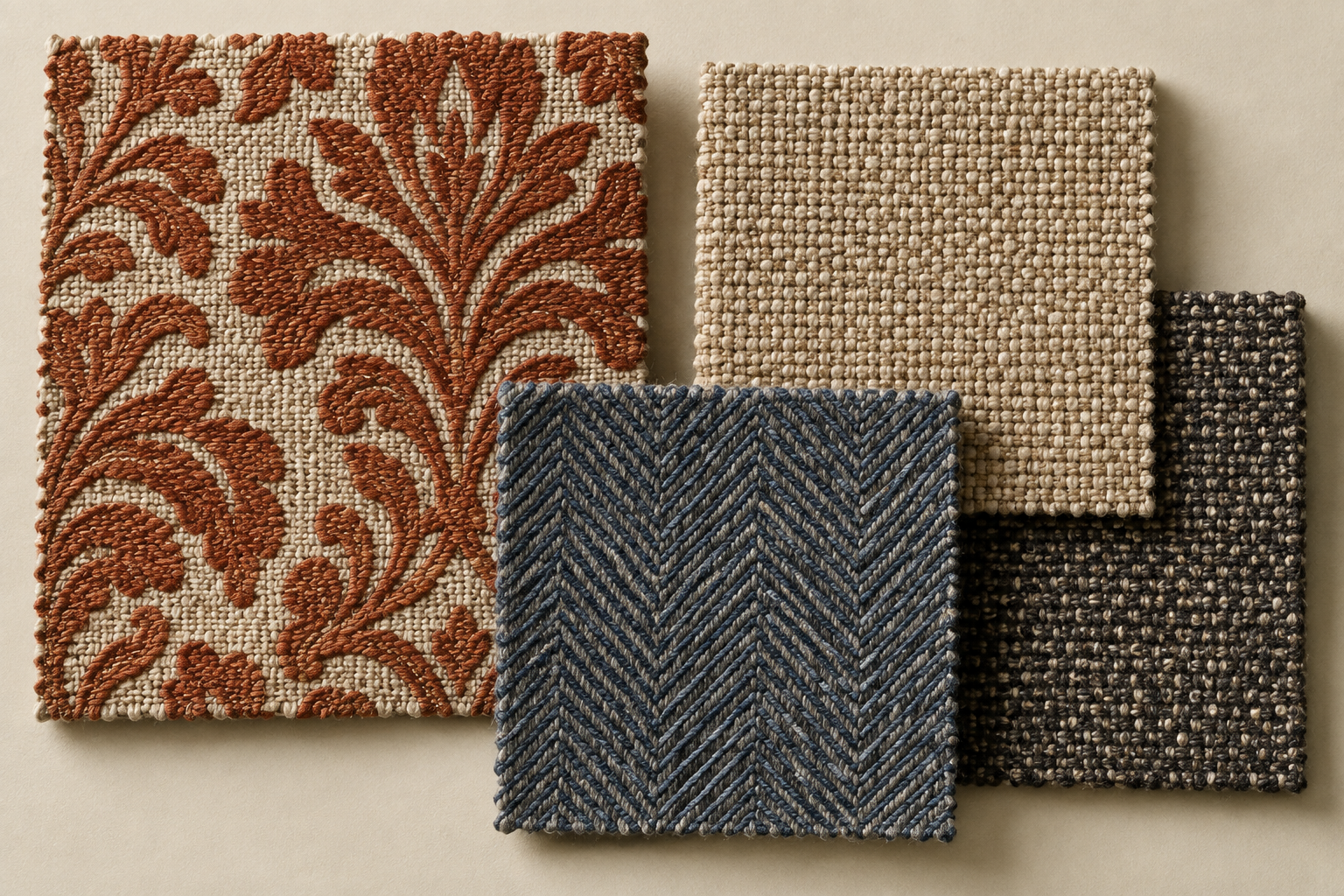
Dobby structures create small geometric or textured effects through controlled shedding. Jacquard mechanisms control individual warp yarns or groups to form more complex woven motifs, which can be structural rather than printed. When the pattern is part of the construction, ask how the reverse side, repeat, scale, edge, and finished weight will appear on the final item.
Basket weave and herringbone
Basket weave groups yarns to create a more open or grid-like interpretation of plain weave. Herringbone is a broken twill effect that creates a recognisable V-shaped direction. Both names describe construction or visual structure; the product brief should still state fibre, weight, width, finish, and intended use.
| Weave direction | How it is formed | Typical surface | Useful starting point | What to confirm |
|---|---|---|---|---|
| Plain weave | Simple over-under repeat | Balanced and stable | Light apparel, linings, everyday fabrics | Density, weight, drape, opacity |
| Twill | Offset interlacing creates a diagonal | Defined line and controlled body | Apparel, accessories, printed scarves | Direction, scale, width, finish |
| Satin | Longer floats across the surface | Smooth and reflective | Fluid luxury surfaces and formal products | Snag risk, care, surface movement |
| Jacquard | Individual warp control for motifs | Woven relief or complex pattern | Decorative fabrics and statement products | Repeat, reverse, weight, edge |
| Basket or herringbone | Grouped yarns or broken twill layout | Grid, chevron, or directional texture | Structured apparel and home textiles | Pattern scale, fray, finished hand |
What Properties Matter in Woven Fabric?
Two fabrics can share the same fibre and still give different results because construction and finishing change the way the fabric moves, reflects light, absorbs moisture, holds colour, and responds to cutting. Evaluate the following properties on a representative finished sample.
Dimensional stability
Check finished width, length, shrinkage, skew, bow, and whether the fabric stays square after the planned care or finishing route. A stable woven fabric may be useful for accurate cutting, but stability must be measured rather than assumed from the weave name.
Drape and hand feel
Hand feel includes softness, body, smoothness, crispness, fullness, and surface friction. Drape describes how the fabric falls and folds. Review both with the finished width, hem, lining, and intended product shape, because a flat swatch does not reproduce the complete product.
Stretch, bias movement, and recovery
Most basic woven structures have less crosswise stretch than knits, but woven fabric can still move on the bias, use elastane, or be engineered with a looser construction. Record stretch direction and recovery if the product must fit, wrap, or return to shape.
Edge behavior and fraying
Cut edges can fray when yarns are released from the interlacing. Test the proposed hem, overlock, binding, fringe, or sealed edge on the actual weight and finish. For scarves and narrow accessories, edge treatment can change both appearance and durability.
Opacity, breathability, and surface response
Opacity depends on yarns, density, colour, weight, and lighting. Breathability is also a construction-and-finish question, not a fibre-only promise. Check the fabric against the intended skin tone, background, climate, and use conditions.
Print, colour, and texture
Weave structure affects how artwork sits on the surface and how colour is perceived. Request a strike-off or finished sample when placement, repeat, small details, contrast, or colour matching matters. A woven motif, a printed motif, and a jacquard texture should be described as different production routes; printed, woven, and jacquard patterns explains the distinction in more detail.
Woven vs. Knitted vs. Nonwoven Fabric
“Woven” is one construction category. Knitted fabric is formed from loops, while nonwoven material is made by bonding, entangling, or otherwise consolidating fibres without the same warp-and-weft interlacing. The right category depends on the product brief, not on a universal quality ranking.
| Structure | How it is formed | Typical behavior | Buyer checks |
|---|---|---|---|
| Woven | Interlaced warp and weft yarns | Defined grain, shape control, limited or engineered stretch | Weave, width, weight, fray, shrinkage, drape |
| Knitted | Interconnected yarn loops | More natural stretch and conformability in many constructions | Loop type, stretch, recovery, ladders, warmth, width |
| Nonwoven | Fibres bonded or mechanically entangled | Can range from soft sheets to technical or filter structures | Basis weight, bonding, tear, thickness, lamination, use limits |
Fibre labels do not resolve this comparison. Cotton can be woven or knitted; polyester can be woven, knitted, or nonwoven; silk is commonly woven but the product name still needs a construction and finish. Put the structure in the request for quotation so suppliers are comparing the same type of material.
Where Is Woven Fabric Used?
Apparel, scarves, and accessories
Woven fabrics are used for shirts, dresses, tailoring, linings, scarves, bandanas, ties, hair accessories, and other products that need a defined surface or controlled cutting direction. The suitable construction depends on whether the item needs fluid drape, body, opacity, print clarity, or a stable edge.
Home and interior textiles
Woven fabric also appears in curtains, cushions, table textiles, bedding, upholstery, and decorative panels. For these uses, width, abrasion, seam performance, light exposure, cleaning, and dimensional stability can matter as much as appearance.
Technical and industrial products
Woven structures are used in selected technical textiles, reinforcement systems, filtration supports, workwear, and protective products. These applications require a defined performance specification and appropriate testing; a general fabric name is not enough to establish suitability.
How Should You Specify Woven Fabric for a Project?
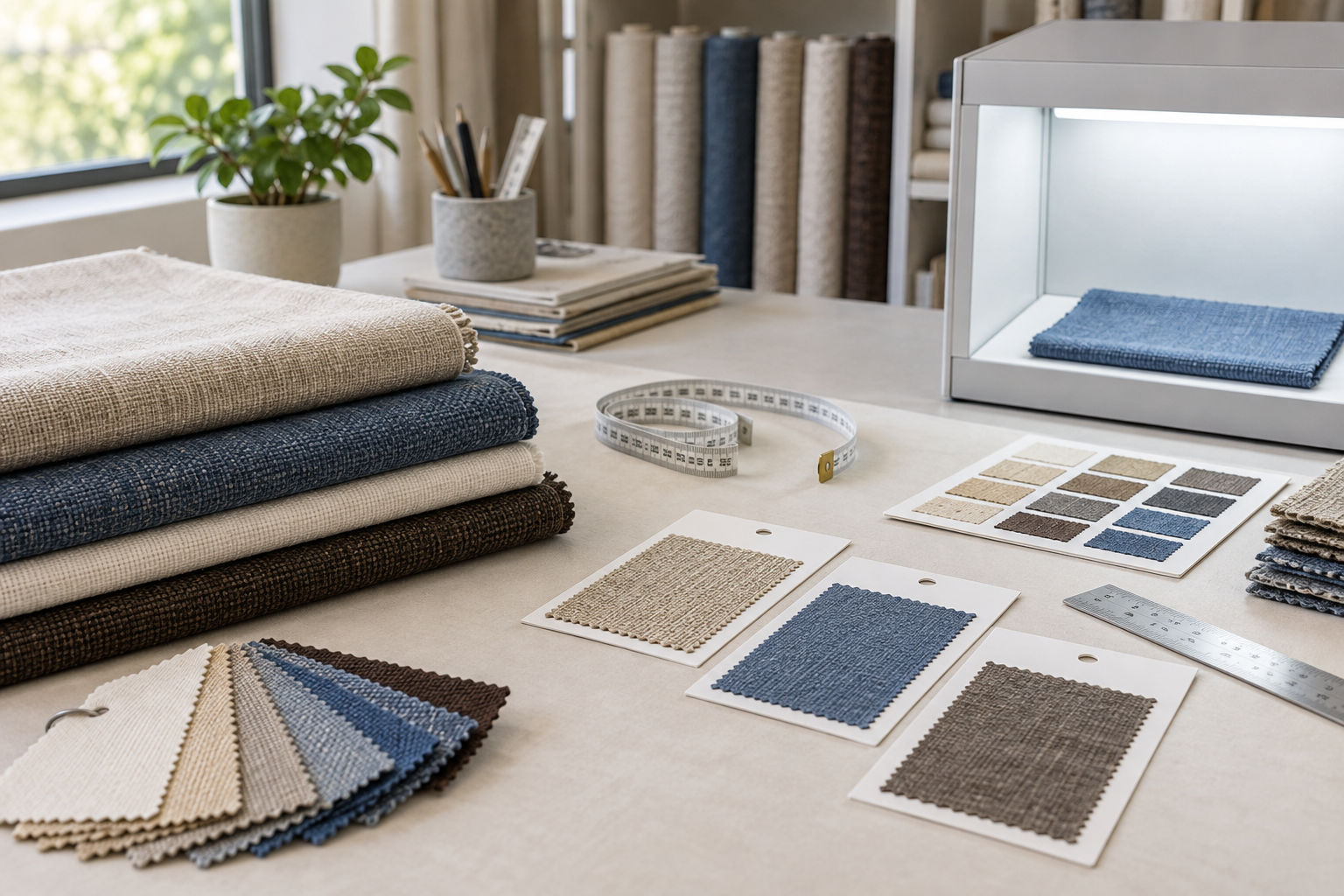
A good woven-fabric brief turns a visual idea into a set of checkable variables. Include:
- End use: define the finished product, market, climate, wear pattern, and care route.
- Fibre and blend: state the intended fibre family and any blend range or generic label requirement.
- Construction: name plain, twill, satin, jacquard, dobby, basket, herringbone, or another required structure.
- Weight and width: use GSM, momme, ounces, or another agreed unit, and distinguish loom width from usable finished width.
- Surface and finish: state matte, lustrous, brushed, crisp, soft, coated, washed, or another target with a reference sample.
- Artwork and colour: provide print placement, repeat, scale, colour references, and whether the pattern is printed or woven.
- Finished construction: include cut size, grain direction, hem or edge treatment, labels, and packaging requirements.
- Acceptance checks: agree how to review colour, weight, dimensions, shrinkage, opacity, hand feel, and visible defects.
For a structured decorative option, review silk jacquard fabric. For a diagonal surface suited to many printed textile briefs, compare silk twill fabric. These are starting points for specification, not substitutes for approving the exact sample.
How Do You Test Woven Fabric Before Bulk Production?
A construction check validates the specified weave, fibre direction, width, and weight, but it cannot validate the final wearing result by itself. Required inputs for production handoff include the approved sample, colour review, measurement record, and finished edge.
Testing should follow the risk of the product. A scarf, upholstery panel, and industrial fabric do not need an identical test plan, but each needs a documented comparison between the approved sample and the production material.
Check construction and dimensions
Confirm fibre composition, weave, yarn direction, width, weight, pattern repeat, skew, bow, and edge condition. Measure several points rather than relying on one reading, especially when the finished item requires accurate placement or a consistent cut length.
Check appearance and handling
Review the fabric under the lighting in which it will be sold or worn. Compare colour, lustre, transparency, drape, surface texture, print sharpness, and visible defects. Handle the fabric after the planned finishing and inspect the proposed edge.
Check performance with an agreed method
Choose test methods that match the use. ASTM D3885 addresses abrasion resistance of textile fabrics, including woven and nonwoven fabrics, while ASTM D1683/D1683M addresses sewn seam failure in woven fabrics. These standards do not make a fabric automatically suitable; they provide methods that should be selected and interpreted for the product.
Approve the finished sample
The final approval should use the actual fabric, colour or artwork, dimensions, edge finish, labels, and packaging route wherever possible. If the product is sold in a regulated market, also verify the applicable fibre-content labelling; the UK textile-labelling guidance is one market-specific example. Keep the approved sample and measurement record as the reference for bulk production.
Frequently Asked Questions
Is cotton woven fabric?
Cotton is a fibre, not a construction. Cotton can be woven into poplin, canvas, voile, sateen, and other fabrics, or knitted into jersey and other loop structures. The product specification should state both the cotton content and the construction.
Do woven fabrics stretch?
Some woven fabrics stretch through bias movement, a loose construction, elastane, or a designed mechanical stretch. Many basic woven fabrics stretch less than knits. Measure the direction, percentage, and recovery when fit or wrapping performance matters.
Is satin always silk?
No. Satin identifies a weave or surface family with longer floats and a smoother face. Silk satin, polyester satin, acetate satin, and other versions can share a general appearance while differing in hand feel, care, drape, and price position.
What is the best woven fabric for scarves?
There is no universal answer. Silk twill may suit a defined printed scarf, silk satin may suit a smoother formal look, and a lighter plain weave or chiffon may suit an airy product. Compare the intended weight, width, opacity, drape, edge, artwork, and finished sample.
Is woven fabric better than knitted fabric?
Neither category is automatically better. Woven fabric may be preferable for grain control, crisp structure, or a stable printed panel, while knit may be preferable for stretch and close fit. The correct choice follows the end use and the acceptance criteria.
How can I tell whether fabric is woven?
Look for two yarn directions crossing at regular angles, a recognisable grain, and cut-edge behavior consistent with interlaced yarns. A close inspection can help, but a supplier specification or technical sample is more reliable than appearance alone.
Conclusion: Specify the Construction, Not Only the Fibre
Woven fabric is defined by interlaced warp and weft yarns, but that definition is only the starting point. Plain, twill, satin, jacquard, dobby, basket, and herringbone structures can create different surfaces and movement, while fibre, weight, finish, width, and edge treatment determine how the finished product behaves.
For a dependable sourcing decision, write the construction into the brief, compare like-for-like samples, and approve the finished format before bulk production. When the specification covers fibre, weave, weight, width, finish, artwork, testing, and labelling, the question “what is woven fabric?” becomes a practical product decision rather than a vague fabric label.
