Fabric Patterns vs. Fabric Prints: What Is the Difference?

Carina Silk Editorial Team writes practical guides on silk fabrics, scarves and custom textile development, with a focus on materials, artwork, sampling, construction and finishing decisions.
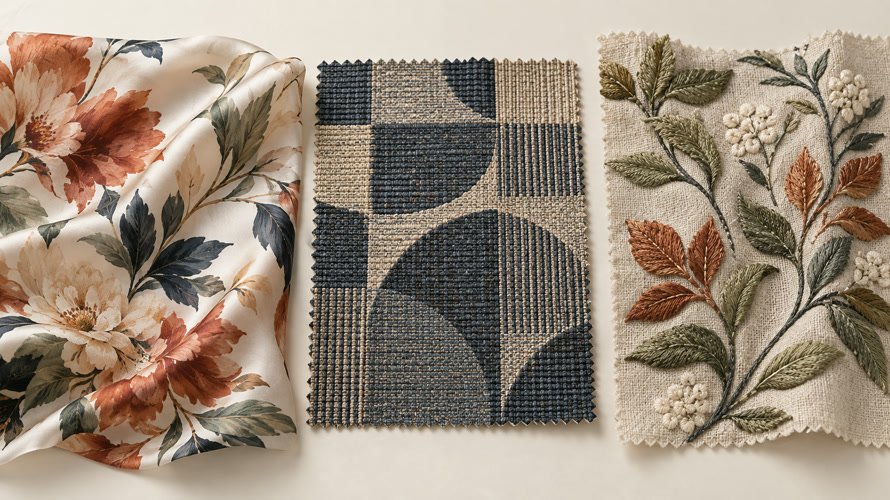
A fabric pattern is the visual or structural design on a textile, while a fabric print is one way to put colour or artwork onto the fabric surface. A stripe, floral, paisley or geometric motif can be printed, woven, developed as jacquard or added through embroidery. The name of the pattern does not identify the construction route.
This distinction matters when you are sourcing a custom fabric or scarf. A printed damask reference and a woven jacquard damask may look related but can differ in surface texture, reverse side, drape, colour response and sampling method. The correct brief therefore states both what the design should look like and how it should exist on the cloth.
What Is a Fabric Pattern?
A fabric pattern is a motif, structure or arrangement that gives the textile its visual identity. It can be a repeated field, a stripe, a check, a border, a centre placement, a woven contrast or a raised decorative element.
Pattern is therefore a broad design term. It describes the visible result or the arrangement logic, but it does not automatically specify fibre composition, weave, weight, width, finish or print method. The fabric patterns guide covers common motif families; this article focuses on the production distinction behind the vocabulary.
For example, a floral pattern may be a digital print on silk, a woven jacquard motif, an embroidered decoration or an engineered border. The flower is the design idea. The route controls how that idea behaves on the fabric.
What Is a Fabric Print?
A fabric print is colour or artwork applied to a textile surface through a printing process. The artwork may be a repeating tile, a border, a panel, a placement image or a full-width composition. Printing can support detailed linework, gradients and custom colour arrangements, but the final result still depends on the selected base fabric and finishing.
Print is not a synonym for pattern. A print may create a pattern, but it may also be a single placement illustration or a non-repeating panel. Conversely, a woven structure can carry a pattern without using a surface print.
The practical brief should state the required inputs: print route, artwork dimensions, repeat or placement, colour references, bleed, safe area and finished product orientation. For a scarf project, the digital printed scarves page is the relevant next step when the chosen route is surface printing.
How Are Fabric Patterns and Prints Related?
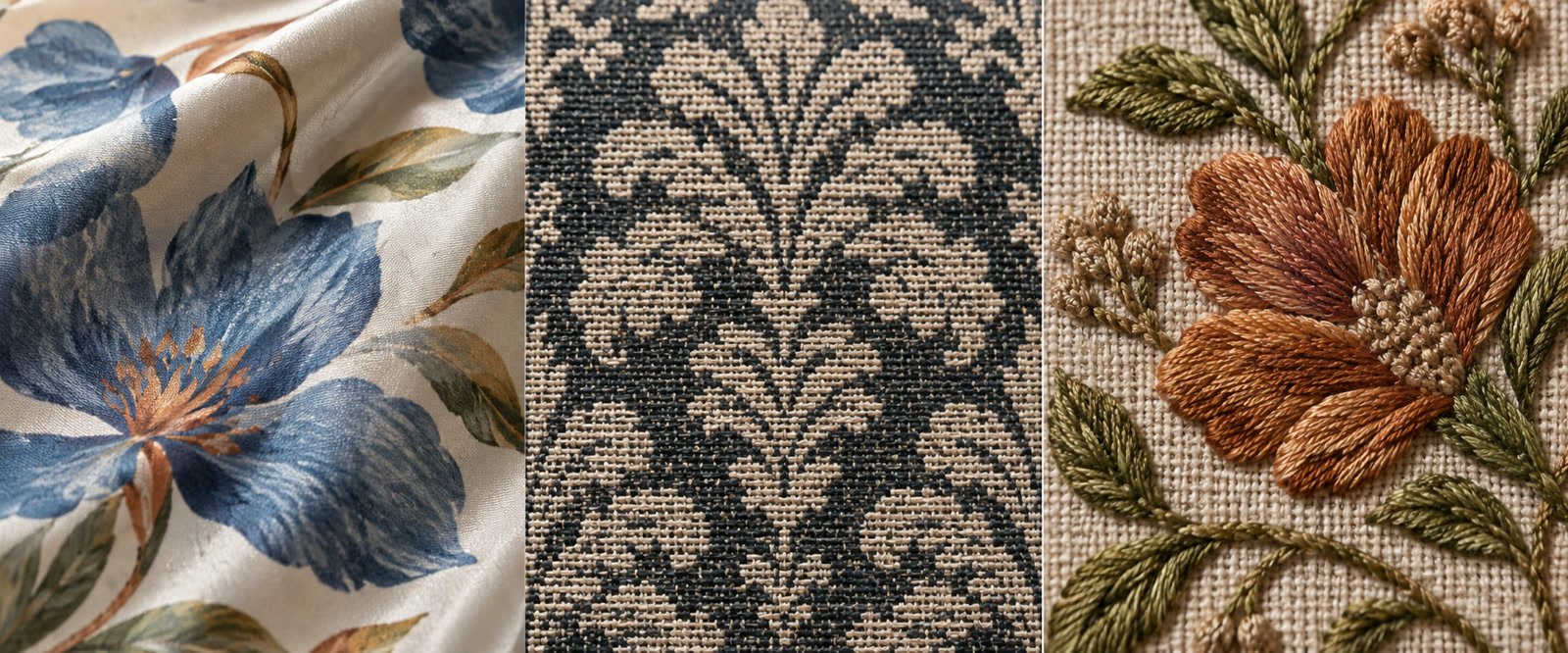
The relationship is easiest to understand through the physical route. Pattern answers “what should the design look like?” Print answers “how is colour or artwork applied to the fabric?” Weave, jacquard and embroidery answer different versions of the second question.
Surface-printed pattern
A surface-printed pattern is transferred onto an already constructed textile. Digital printing is often considered when a brief contains detailed artwork, tonal gradients, multiple colours or a custom repeat. Screen and other printing routes may also suit a different scale, material or production brief.
The print does not remove the importance of the base fabric. Silk, viscose, cotton, polyester and blended constructions can produce different colour depth, softness, texture and drape. A screen preview cannot validate all of those variables, so a selected-fabric swatch or strike-off remains important.
Woven or jacquard pattern
A woven pattern is formed through the relationship between warp, weft, yarn colour and weave structure. Jacquard is a construction method that can control complex woven motifs. The pattern is therefore part of the cloth structure rather than simply a coloured image placed on top.
That does not mean every woven pattern has the same relief, reverse side or performance. Fibre, yarn, weave, weight and finishing still change the result. A screen preview cannot validate the complete physical result, so if the requirement is a pattern built into the cloth, compare the reference with a woven sample and specify the construction directly. The silk jacquard fabric page is the matching Carina destination for that direction.
Embroidered or raised pattern
Embroidery adds thread-based decoration to a base fabric. It can create relief, selective motifs, lettering or a crafted surface, but it is not the same as printing or jacquard weaving. Stitch density, backing, placement and edge behaviour become part of the brief.
An embroidered floral and a floral print can use the same drawing while producing different hand feel, weight and care considerations. The buyer should therefore use the visual name as a reference, then state the intended route.
What Changes for a Textile Buyer?
| Decision area | Surface print | Woven or jacquard pattern | Embroidered pattern |
|---|---|---|---|
| How the design is formed | Colour or artwork is applied to the fabric surface | Yarn and weave structure form the motif in the cloth | Thread is stitched onto or through the base |
| Surface response | Usually follows the base fabric surface | Can add structure, contrast or relief depending on construction | Adds localised tactile relief and thread detail |
| Artwork flexibility | Often suitable for detailed artwork and custom colourways | The design must be translated into a weave structure and yarn plan | Motif must be converted into stitch and placement information |
| Reverse-side result | Depends on fabric, coverage and print route | Depends on yarns, weave and construction | May show thread, backing or a different reverse appearance |
| Main buyer risk | Colour and detail may change on the selected fabric | A printed reference may not translate into the same surface | Stitch density, placement or backing may affect the product |
| What to approve | Artwork proof, swatch/strike-off and finished sample | Woven sample, dimensions and finished sample | Embroidery sample, placement, backing and finished sample |
The important point is that none of these columns is automatically “better.” The suitable route depends on the product, design intent, surface, hand feel, quantity, repeat, finished dimensions and acceptance criteria.
How Do You Specify a Patterned Fabric?
Start with the visual requirement
Name the motif family, colour direction, density, scale and whether the artwork is all-over, border, centre placement or a single panel. If the pattern has a clear top and bottom, record the direction. If it must be mirrored or matched, show the intended alignment.
State the construction route
Write “surface print,” “woven pattern,” “jacquard,” “embroidery” or another verified route instead of using “patterned fabric” alone. If the route is open to discussion, say what must remain constant: the flat printed appearance, the woven relief, the colour relationship, the reverse side or the product hand feel.
Match the route to the product
For a printed scarf, check how the artwork meets the border, hem, folds and corners. For a woven or jacquard fabric, check how the motif scale works with the width, drape and reverse side. For a printed viscose brief, compare the artwork with the selected base and make sure the printed viscose fabric requirement is stated separately from the generic pattern name.

Approve like-for-like samples
Do not compare a high-resolution printed image with a finished jacquard sample and treat the difference as a quality score. Compare like-for-like route, fabric, scale and dimensions. Record acceptance criteria before sampling so the sample shows the physical decision that the quotation is expected to deliver.
Conclusion
Fabric pattern and fabric print are related but not interchangeable terms. A pattern describes a visual or structural design. A print describes one surface-application route. Woven, jacquard and embroidered patterns can share a motif while producing a different surface, hand feel, reverse side and sample requirement.
For a reliable custom textile brief, state the motif, scale, repeat or placement, base fabric, construction route, finished dimensions, colour references and approval checks. That gives the production discussion a physical specification instead of a visual name alone.