What Is Ramie Fabric? Properties, Uses and Buyer Checks

Carina Silk Editorial Team writes practical guides on silk fabrics, scarves and custom textile development, with a focus on materials, artwork, sampling, construction and finishing decisions.
- What Is Ramie Fabric?
- What Is Ramie Made From?
- How Is Ramie Fibre Processed into Fabric?
- What Are the Key Properties of Ramie Fabric?
- What Are the Advantages and Limitations of Ramie Fabric?
- Ramie vs Linen vs Cotton: How Do They Compare?
- Where Is Ramie Fabric Used?
- How Should You Evaluate Ramie Fabric Before Buying?
- How Should Ramie Fabric Be Cared For?
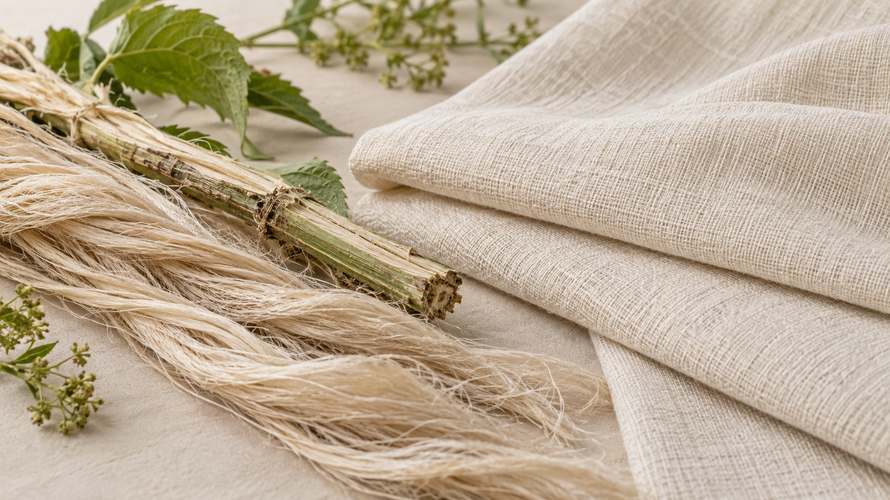
Ramie fabric is made from ramie, a natural cellulosic bast fibre obtained from the stem of the ramie plant. It is known for a naturally bright surface, a crisp-to-smooth hand depending on processing, and a useful balance of strength and breathability. It can be made into fabrics for apparel, home textiles and blended constructions.
The important qualification is that “ramie” describes the fibre direction, not one fixed fabric construction. A ramie plain weave, a ramie blend, and a finished ramie fabric with a softening treatment can behave very differently. For a product developer or buyer, the useful question is not only whether a fabric contains ramie, but how the fibre was prepared, spun, woven or knitted, finished and tested.
What Is Ramie Fabric?
Ramie is a plant-based fibre classified as a natural cellulosic bast fibre. Bast fibres come from the inner part of a plant stem rather than from a seed, as with cotton. The fibre is separated from the stem, cleaned and prepared before it can be spun into yarn.
Ramie fabric therefore sits at the intersection of fibre identity and textile construction. The fibre can contribute lustre, strength, absorbency and a characteristic dry or crisp hand. The construction and finishing decide how those tendencies appear in the finished product. Yarn size, fabric density, GSM, blend percentage, dyeing and finishing can all change drape, opacity, surface feel and care behavior.
This distinction is useful when comparing ramie with other natural fibres. A fabric label may tell you the fibre content, but it may not tell you whether the cloth is a loose plain weave, a compact twill, a gauzy voile or a blended fabric designed to soften the hand.
What Is Ramie Made From?
Ramie is made from the cellulose-rich inner fibres of the ramie plant, commonly associated with *Boehmeria nivea*. The raw fibre is not normally ready to use as yarn immediately after harvest. It contains natural gums and non-cellulosic materials that must be reduced or removed during preparation.
That preparation is one reason two fabrics described as ramie can have different surfaces. A more thoroughly prepared fibre may be spun into a smoother yarn, while a different route, yarn, blend or finishing treatment may preserve more of the characteristic crispness and natural texture.
For a buyer, the practical record should include the fibre composition and the construction. “Ramie” is a starting point for a material conversation, not a complete performance specification.
How Is Ramie Fibre Processed into Fabric?
The route varies by mill and product, but a simplified sequence is:
- Harvesting: mature plant stems are collected for fibre extraction.
- Fibre separation: the outer material and woody parts are removed so the bast fibre can be recovered.
- Degumming and cleaning: gums, pectins and other non-cellulosic materials are reduced to make the fibre more suitable for spinning.
- Fibre preparation: the fibres are aligned, opened and prepared for yarn formation.
- Spinning: prepared fibres are twisted into yarn with a selected yarn size and character.
- Construction: the yarn is woven or knitted into the required fabric structure.
- Finishing: washing, softening, dyeing, printing or other finishing steps alter the surface and final hand.
Degumming is especially important because it changes how the bast fibre can be handled and spun. Research into ramie processing also shows why a processing method should not be treated as a minor detail: the route can affect fibre quality and the balance between clean surface, strength and usability. For general textile context, see ramie degumming research from Oak Ridge National Laboratory.
The finished fabric still needs to be assessed on its own terms. A processing description cannot replace a sample because the yarn, construction, blend, weight and finishing route continue to shape the result.

What Are the Key Properties of Ramie Fabric?
Strength, lustre and shape retention
Ramie is often selected for its strength direction, natural lustre and ability to contribute structure to a fabric. These properties can be useful when a product needs a visible natural surface or a cloth that does not collapse into a completely fluid drape.
The result is not identical across all qualities. Yarn construction, fabric density and finishing can make one ramie fabric feel smooth and controlled while another feels more open, dry or textured. Confirm the finished weight and hand instead of treating “ramie” as a fixed grade.
Breathability and absorbency
Like other natural cellulosic fibres, ramie can absorb moisture and support a breathable fabric direction. Comfort still depends on the finished construction. A dense, heavy fabric and a light, open fabric made from related fibre content will not feel the same in wear.
The safest specification describes the intended use, weight, construction and finishing together. A useful external reference is the University of Georgia fibre guide, which lists practical strengths and limitations for ramie rather than treating it as universally suitable.
Crisp hand, low elasticity and wrinkle risk
Ramie commonly has lower elasticity than fibres designed for stretch and recovery. It may also show creasing or a crisp hand, especially when the fabric is light, dry or loosely finished. That can be attractive for a structured natural look, but it may be less suitable when the brief requires a very fluid drape or high recovery after movement.
For a scarf or accessory, assess the actual fold, knot, edge and recovery behavior. A flat swatch may look promising while the finished dimensions reveal more creasing, more transparency or less grip than the product requires.
Blends and finishing
Blending ramie with cotton, linen, silk or other fibres can rebalance hand feel, drape, cost, surface character and care requirements. Finishing can also soften or compact the surface, change lustre, and influence how colour or artwork appears.
This is why a buyer should record blend percentage, construction, GSM, width and finishing route. The fibre name alone cannot predict the final fabric.
What Are the Advantages and Limitations of Ramie Fabric?
Ramie can be a useful direction when the brief values a natural cellulosic fibre, visible surface character, breathability and a more structured hand. It can also contribute strength and lustre to a blend. Its limitations are equally important: low elasticity, crease sensitivity, possible stiffness or brittleness, abrasion concerns in some constructions, and care behavior that varies with the finished fabric.
| Potential advantages | Limitations to investigate |
|---|---|
| Natural cellulosic bast-fibre direction | Lower elasticity than stretch-oriented fibres |
| Natural lustre and visible surface character | Can crease or hold a crisp fold |
| Absorbency and breathable potential | Comfort depends on weight and construction |
| Can contribute strength and structure | Some qualities may feel stiff or brittle |
| Useful in blends | Blend and finish change the result substantially |
| Suitable for apparel and home-textile directions | Care and colourfastness must be checked on the actual quality |
The correct conclusion is not that ramie is better or worse than linen or cotton. It is that ramie offers a different set of trade-offs, and the trade-offs should be tested against the product brief.
Ramie vs Linen vs Cotton: How Do They Compare?
Ramie, linen and cotton are all associated with natural cellulosic textiles, but the comparison is not a simple quality ranking. Fibre, yarn, construction, weight and finishing can move the finished result in different directions.
| Material direction | Typical hand and drape | Strengths to investigate | Common limitation | Buyer checks |
|---|---|---|---|---|
| Ramie | Crisp to smooth, depending on processing and blend | Lustre, strength direction, breathability | Low elasticity and crease sensitivity may matter | Degumming, blend, GSM, finish, shrinkage |
| Linen | Dry and textured to softened | Breathability and natural-fibre character | Creasing and surface variation | Yarn, weave, weight, wash route |
| Cotton | Soft to structured, depending on construction | Familiar sourcing and broad range of weights | Absorbency, shrinkage and shape behavior vary | Composition, weave, finish, colourfastness |
If the product needs a more defined natural surface, ramie may be worth sampling. If it needs familiar softness, a broad cotton range may be easier to tune. If it needs a dry, textured handle and established linen character, linen may be the more direct starting point. The finished sample decides whether the direction works.
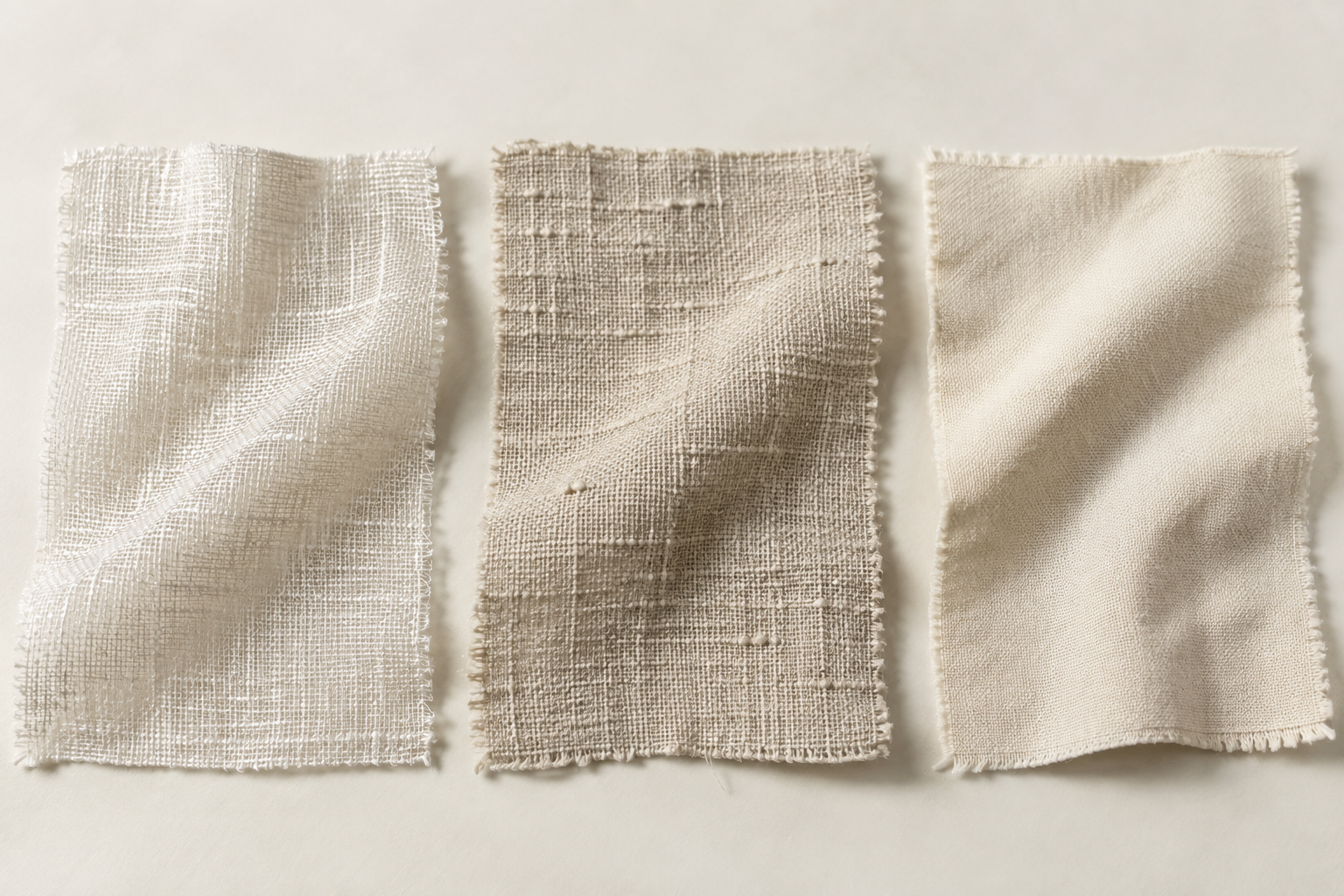
For a construction-first explanation, see how woven construction affects fabric behavior. A fibre comparison should not be separated from the way the cloth is actually made.
Where Is Ramie Fabric Used?
Ramie can be used in apparel, lightweight layers, shirts, dresses, jackets, home textiles and blended fabrics. The best use depends on how the fibre is processed and how the fabric is constructed.
For scarves and accessories, the evaluation should be more specific. Check whether the fabric has the required drape, opacity, skin feel, fold recovery, edge behavior and print surface. A ramie blend may be more appropriate than a 100% ramie fabric when the brief calls for a softer hand, a smoother knot or a more fluid movement.
For home textiles, consider dimensional stability, laundering, abrasion and the required surface appearance. For apparel, consider seam behavior, comfort, crease management and the care route. For either category, approve the finished sample rather than relying on a fibre description.
How Should You Evaluate Ramie Fabric Before Buying?
Before requesting a quote or approving a bulk quality, turn the visual brief into a short technical checklist:
- Composition: What is the ramie percentage? Is the fabric blended, and are the percentages confirmed?
- Construction: Is it plain weave, twill, gauze, knit or another construction? Which direction is the grain?
- Weight and width: Record GSM, finished width and any tolerance that matters to cutting or printing.
- Hand and drape: Is the hand crisp, dry, soft, fluid or structured? Does it recover after folding or knotting?
- Surface and opacity: Check lustre, slubs, transparency, hairiness and whether the surface matches the intended product.
- Colour and artwork: Confirm the ground colour, dye or print route, colour target and whether the artwork needs a strike-off or finished sample.
- Dimensional stability: Measure shrinkage or skew after the relevant care or finishing route.
- Edge and seam behavior: Check fraying, rolled edges, seam movement and the finished hem or border.
- Care: Follow the actual care label and confirm whether washing, drying or pressing changes the hand or dimensions.
- Sample approval: Keep the approved swatch and, when the product is dimension-sensitive, approve a finished-size sample as well.
The fabric swatch is a decision tool, not just a colour reference. It helps the buyer compare the surface, weight, hand, construction and finish that will influence the final product.

How Should Ramie Fabric Be Cared For?
Care depends on the fibre blend, construction, dye, finish and garment design, so the care label should be the first reference. A ramie quality that has been softened, blended or specially finished may require a different route from a crisp, lightly finished fabric.
Before production, confirm the intended washing, drying and pressing conditions. Check whether the fabric creases, shrinks, changes hand or loses surface appearance after the relevant care test. Avoid approving a universal wash routine from the fibre name alone.