
What Is Suede Fabric? Properties, Types, Uses and Buyer Checks

Carina Silk Editorial Team writes practical guides on silk fabrics, scarves and custom textile development, with a focus on materials, artwork, sampling, construction and finishing decisions.
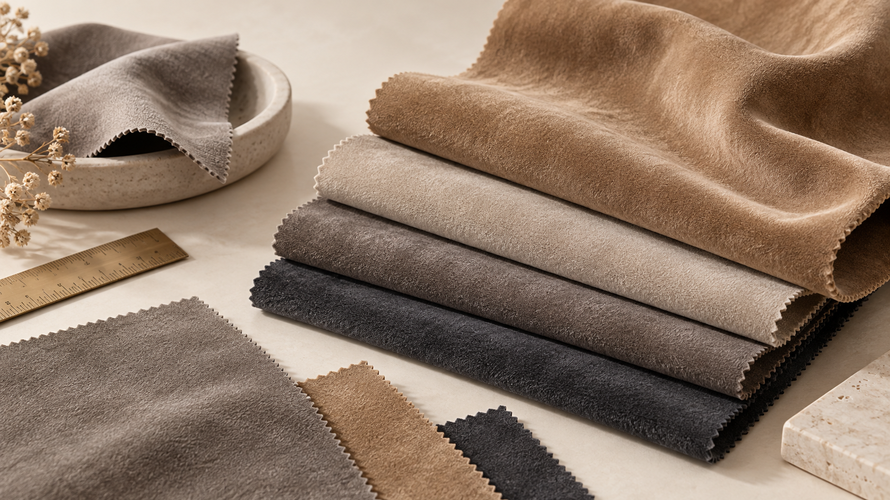
Suede fabric is a textile with a soft, brushed or sanded face that resembles suede leather. In textile supply, the term usually refers to faux suede, microsuede or suedette rather than animal leather. That distinction matters because the fibre, base construction, backing, care route, stretch and price position can all change from one product to another.
For a buyer, “suede” is a starting description, not a complete specification. A supplier should be able to explain what the base is made from, how the surface is created, whether the material stretches, how the nap runs, and how the finished product performs after printing, cutting, sewing or cleaning.
What Is Suede Fabric?
Suede fabric is a textile surface designed to have a low-lustre, velvety nap. The nap is made from short fibres or a raised surface that changes the way light is reflected when it is brushed in different directions. This creates the soft touch and subtle directional shading associated with suede.
Unlike a fibre name such as silk, cotton or polyester, suede describes appearance and surface effect. A suede-like textile may be woven, knitted or made with another textile base, and it may use polyester microfibres, a blend or another specified fibre system. Some versions include a backing or binder to stabilise the face; others use stretch yarns for closer-fitting applications.
The safest specification uses several fields together: fibre content, base construction, finished width, weight, face and back appearance, nap direction, stretch and recovery, colourfastness, abrasion or pilling performance, and care instructions. If any of those fields is missing, the name alone does not tell you enough about the finished material.
The faux suede glossary from MPattern describes the raised microfibre surface that gives this textile direction its characteristic hand.
Is Suede Fabric Real Suede Leather or Faux Suede?
Real suede is leather. It is produced from the flesh side of an animal hide and mechanically buffed to create a soft nap. It is not a woven or knitted fabric, even though it can be used in many of the same product categories as a textile.
Faux suede is a textile alternative. It is commonly made from fine synthetic microfibres and finished by brushing, sanding or another surface treatment. The trade may also use names such as microsuede, suedette, synthetic suede or suede-effect fabric. These names are related, but they should not replace an actual composition and construction specification.
The visual difference is not always enough to identify the material. A textile may imitate the colour and hand of leather, while a real suede may vary according to hide, split, finishing and thickness. Ask for the technical sheet and inspect the cut edge, reverse side, backing, nap and care route before treating a material as equivalent. The real suede and faux suede material guide is useful background for this distinction.
| Material term | What it usually describes | What to confirm |
|---|---|---|
| Real suede | Leather with a buffed flesh-side nap | Hide source, thickness, finish, colour and leather care |
| Faux suede | Textile made to imitate suede’s nap and hand | Fibre, base construction, backing, nap and cleaning route |
| Microsuede | Fine-fibre synthetic suede-effect textile | Microfibre composition, surface density, weight and pilling |
| Suedette | Trade term for a suede-like textile | Supplier-specific composition and finished performance |

How Is Faux Suede Fabric Made?
There is no single manufacturing route for every faux suede fabric, but the surface is generally engineered through a textile base and a finishing process. Fine fibres can be woven or knitted into a base and then raised, brushed, sanded or otherwise treated so that the face develops a short nap. A backing, coating or binder may be added when the product needs more body, stability or a particular reverse appearance.
The face and back should be assessed separately. A soft face may sit over a knitted base, a woven base, a stretch construction or a stabilised backing. That difference changes how the material drapes, stretches, frays, accepts a seam, reacts to heat and behaves after washing or cleaning.
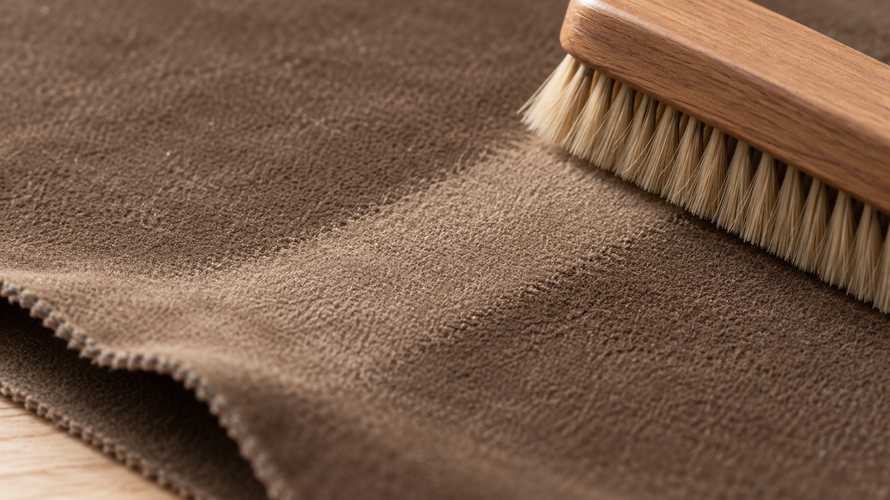
Nap direction is another important variable. Brushing the surface one way can make it look lighter or darker than brushing it the other way. During cutting, all pattern pieces may need to follow the same direction. Otherwise, two pieces dyed to the same colour can appear mismatched when placed next to each other. The Nooteboom suede fabric guide also highlights construction, surface and end-use variables that should stay in the specification.
What Are the Main Types of Suede Fabric?
The fibre direction is only the starting point. The finished fabric can be woven or knitted, pure or blended, smooth or textured, lightweight or structured.
Woven Faux Suede
Woven faux suede has a warp-and-weft base. It may provide a more stable panel, controlled grain and cleaner edge behaviour than a very loose construction, although the actual result depends on the yarns and finishing. It can suit structured accessories, apparel panels, soft furnishings and other products where shape retention matters.
Knitted or Stretch Suede
Knitted suede or suede-effect stretch fabric can be more flexible and close-fitting. Stretch direction, recovery and seam extension become part of the product specification. A soft hand alone does not confirm that the material will recover after repeated wear, so test the finished construction rather than judging a roll in isolation.
Bonded or Backed Suede-Effect Fabric
Some suede-effect materials have a backing or bonded layer. The backing can add stability, opacity or body, but it can also change breathability, drape, thickness and cleaning requirements. Inspect the bond after bending, rubbing, washing or dry cleaning as appropriate to the intended use.
Lightweight Microsuede
Lightweight microsuede keeps a soft nap while remaining easier to drape. It may suit lighter apparel, linings, accessories or decorative applications. Because “lightweight” is not a fixed standard, confirm actual finished weight, width and opacity.
Heavy Suede-Effect Textile
Heavier suede-effect textiles are often selected for furnishings, bags, footwear details or products that need a fuller hand. Heavy does not automatically mean better: abrasion, seam performance, colourfastness, cleanability and surface recovery still need to match the use case.
| Type | Typical strength | Possible limitation | Key sample check |
|---|---|---|---|
| Woven faux suede | Stable panel and controlled grain | May have limited stretch | Edge fraying, drape and nap matching |
| Knitted or stretch suede | Flexibility and close fit | Recovery and weight may vary | Stretch, recovery and seam extension |
| Backed suede effect | More body, stability or opacity | Less fluid; bond may affect care | Bond strength, bending and cleaning |
| Lightweight microsuede | Soft touch with easier drape | May be more transparent or delicate | Opacity, pilling and surface uniformity |
| Heavy suede effect | Fuller hand and greater body | May feel warm or less flexible | Abrasion, drape and finished weight |
What Properties Matter When Choosing Suede Fabric?
The useful properties are the ones that affect the finished item and the approval decision.
Hand Feel and Nap
Touch the face in more than one direction. Record whether the nap is short, dense, brushed, velvety or visibly textured. Directional shading is normal for a napped material, so compare the production sample with the approved standard under the lighting used by the customer.
Drape and Body
The base, weight, backing and finish determine whether suede fabric falls softly or holds a shaped form. A fabric that feels luxurious on a small swatch may become stiff when bonded, embroidered, lined or layered. Test the finished assembly whenever the article depends on movement or folding.
Stretch and Recovery
Stretch suede may be comfortable for fitted products, but the amount and direction of stretch must be measured. Check extension, recovery after repeated cycles and seam stability. If the article needs to hold a precise shape, a non-stretch woven construction may be more predictable.
Abrasion, Pilling and Surface Change
Repeated rubbing can flatten a nap, create shine, change the colour direction or produce pills. Ask which test method and result apply to the specific finished material; do not turn one supplier’s test result into a universal claim for every suede fabric.
Colour, Print and Directional Shading
The nap can affect colour appearance and make a surface look different from one direction to the next. If the material is printed, embossed or dyed, compare a finished sample under multiple angles and lighting conditions. A flat colour swatch is not enough when the final product has a visible nap.
Care and Moisture Response
Some synthetic suede fabrics can be machine washed, while others need a gentler route because of the backing, coating, dye or finish. “Faux” does not automatically mean washable or waterproof. Follow the supplier’s care label and test the exact finished construction before making a customer-facing claim.
| Property | Why it matters | What to confirm |
|---|---|---|
| Fibre and base | Sets the starting point for hand, stability, stretch and care | Composition, woven/knit/other construction and reverse |
| Nap and surface | Controls touch, colour direction and perceived quality | Nap height, density, direction and surface uniformity |
| Weight and width | Affects drape, coverage, cutting and finished dimensions | GSM, thickness, usable width and tolerance |
| Stretch and recovery | Changes fit, seam behaviour and shape retention | Direction, extension, recovery and repeated-cycle result |
| Surface durability | Rubbing can flatten or change a napped face | Relevant abrasion, pilling and surface-recovery evidence |
| Colour and print | Nap and finish can change colour perception | Colour standard, print route, strike-off and lighting review |
Suede Fabric vs Real Suede, Velvet and Microfiber
Suede fabric and real suede are not interchangeable terms. Real suede is leather, while faux suede is a textile. Their thickness, edge, moisture response, care and production controls are different.
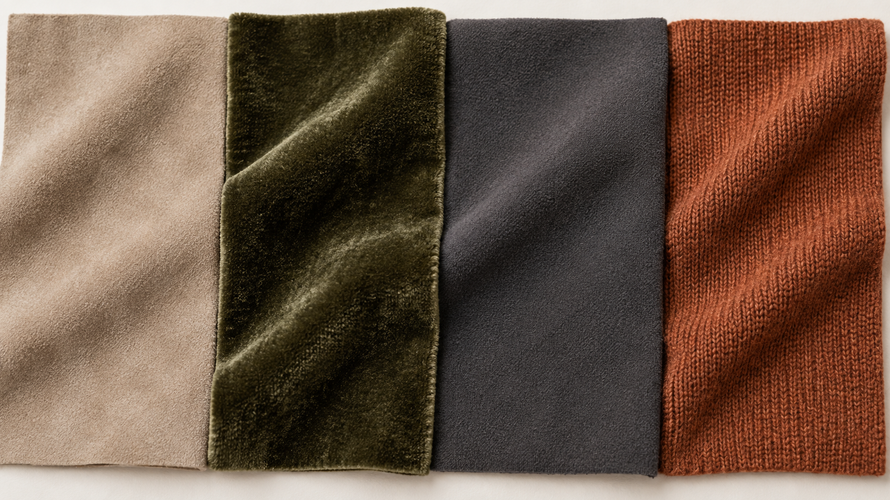
Velvet also has a raised surface, but its pile structure and visual character differ from a short suede-like nap. Microfiber describes a fine-fibre construction, not necessarily a suede finish. A microfibre textile can be smooth, brushed, woven, knitted or coated, while microsuede is one possible finished surface.
| Material direction | Surface character | Typical decision question | What to verify |
|---|---|---|---|
| Real suede leather | Leather nap with natural variation | Does the product require leather? | Hide, thickness, finish, care and edge |
| Faux suede textile | Short, matte, suede-like nap | Does the product need a textile base? | Fibre, construction, backing and nap |
| Velvet | Raised pile with its own direction and lustre | Is a formal pile effect wanted? | Pile height, crushing, seam and care |
| Microfiber textile | Fine-fibre base; surface may vary | Is fine fibre needed for softness? | Fibre, surface finish and performance tests |
Where Is Suede Fabric Used?
Faux suede can be used for apparel panels, skirts, jackets, bags, footwear details, gloves, accessories, soft furnishings and decorative products. The right type depends on the balance between hand feel, structure, stretch, abrasion, care and cost.
For apparel, drape, comfort, stretch and seam behaviour are often central. For bags or structured accessories, body, edge stability and abrasion may matter more. For interiors, cleanability, colourfastness and repeated rubbing can be more important than a delicate hand. These are different briefs even when the customer uses the same word: suede.
If the product will be printed, check whether the face accepts the chosen print process and whether the nap changes colour perception. If it will be cut into panels, confirm nap direction and cutting yield. If it will be sewn, test needle marks, seam slippage, edge fraying and any backing separation. The Threads faux suede handling guide provides practical context for working with a synthetic suede surface.
How Should Buyers Specify and Sample Suede Fabric?
Start with a written specification rather than the material name alone. Ask the supplier to state:
- Fibre content and construction: composition, woven, knitted, bonded or other base, plus any coating, binder or backing.
- Finished dimensions: target weight, thickness, width, usable width and tolerance.
- Surface: face and reverse appearance, nap height, nap direction, hand and colour standard.
- Performance: stretch and recovery, abrasion, pilling, snagging, colourfastness and surface-recovery evidence relevant to the use.
- Care and production: cleaning route, printing or embossing requirement, cutting direction, packing and shade-lot control.
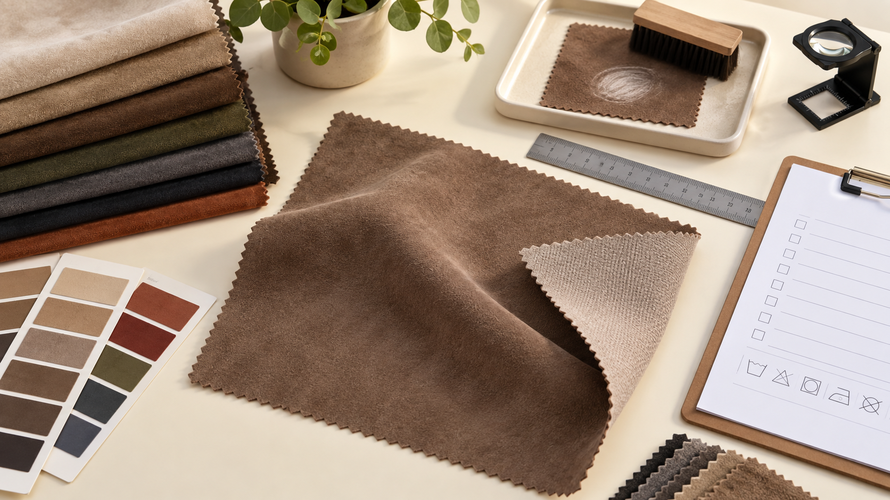
Request a lab dip or strike-off when colour is important, then review a finished sample at the intended size. Use a fabric swatch to compare hand, colour and surface, but do not approve a large order from a small swatch alone if the construction will be cut, lined, bonded, printed or washed.
For a woven suede-effect fabric, review grain and cut-edge behaviour. The woven fabric guide explains why warp and weft direction can affect stability and product performance. For stretch or backed versions, add repeated extension, bending and cleaning checks before bulk production.
Frequently Asked Questions
Is Suede Fabric Real Leather?
Usually, the textile term “suede fabric” refers to faux suede, microsuede or suedette. Real suede is leather made from the flesh side of a hide. Confirm material composition and construction because trade naming is not consistent.
What Is Faux Suede Made Of?
Faux suede is commonly made from fine synthetic microfibres, often polyester, and may include a backing, coating or binder. Exact blends and constructions vary, so use the supplier specification rather than assuming every faux suede has the same formula.
Is Suede Fabric Waterproof?
Not automatically. Water resistance depends on fibre, construction, backing and finish, and a water-resistant surface is not the same as waterproof performance. Test the finished article against the required standard before making a claim.
Does Suede Fabric Stretch?
Some suede-effect fabrics stretch because they use a knitted base or elastane-containing construction, while others have little stretch. Measure stretch and recovery in the intended direction and test the finished seam or product.
Is Suede Fabric Durable?
Durability depends on the base, nap, weight, backing, finish and use. A heavier material is not automatically more durable, and repeated rubbing can change a napped surface. Confirm relevant abrasion, pilling and surface-recovery evidence for the exact fabric.
Is Suede Fabric Breathable?
Breathability varies with construction and backing. A lightly constructed textile may behave differently from a coated or bonded version. If comfort matters, compare air-permeability or wear-test evidence instead of judging by the word “suede.”
Can Suede Fabric Be Washed?
Some synthetic suede fabrics can be washed, but the correct route depends on composition, dye, backing and finish. Follow the supplier’s care instructions and test the finished construction before production or resale.
How Do You Check Suede Fabric Quality?
Check face and reverse, nap consistency, directional shading, width, weight, stretch, recovery, edge, colourfastness, pilling or abrasion performance and care route. Then compare the approved sample with finished production material under realistic lighting and handling.
Conclusion
Suede fabric is best understood as a suede-like textile surface rather than a single universal fibre. The most important distinction is between real suede leather and faux suede textile. After that, compare base construction, nap, backing, hand, drape, stretch, surface durability, colour behaviour and care.
When the material will be printed, cut, sewn, bonded or sold as a custom product, the finished sample is the decision point. A clear specification and controlled sample review will give a more reliable result than approving a material from the word “suede” alone.
