What Is Damask Fabric? Structure, Uses and Buyer Checks

Carina Silk Editorial Team writes practical guides on silk fabrics, scarves and custom textile development, with a focus on materials, artwork, sampling, construction and finishing decisions.

Damask is a woven figured fabric recognised by a reversible pattern and contrasting light reflection. The design is built into the cloth through different warp- and weft-facing areas, commonly on a Jacquard loom. Damask may be made from silk, cotton, linen, viscose or a blend.
Because damask describes construction and pattern effect rather than one fibre, the finished hand can range from light and fluid to firm and furnishing-weight. Buyers should specify fibre, construction, weight, width, repeat, reverse side, finish and intended use together.
What Is Damask Fabric?
Damask is a self-patterned woven fabric in which the figure and ground use contrasting weave faces to reflect light differently. The ACT Contract Textiles glossary describes it as a Jacquard or dobby-woven construction with a reversible effect created by contrasting warp- and filling-faced satin areas.
The Fitzwilliam Museum terminology record also identifies the reverse-position pattern as a defining feature. In practical buying terms, damask is a construction and pattern family, not a guarantee that the cloth is silk or heavy.

How Is Damask Made?
In a classic damask construction, one warp and one weft are organised so that areas of the pattern emphasise different yarn directions or weave faces. A Jacquard mechanism controls the figured design, allowing floral, geometric or large repeat motifs to be woven into the cloth rather than printed on top.
After weaving, finishing such as calendaring, washing, brushing or coating can alter lustre, softness and dimensional stability. A supplier should therefore identify the fibre, weave structure, yarn, weight and finish instead of relying on the word damask alone.
What Are the Main Damask Variations?
Damask can be made in different fibres and weights for apparel, accessories, interiors and table textiles. The pattern may be tonal, contrast-coloured, floral, geometric or custom developed. The table below describes common directions without treating any one fibre as mandatory.
| Direction | Typical hand | Common use | What to confirm |
|---|---|---|---|
| Silk damask | Light to firm, lustrous | Scarves, occasionwear and luxury accessories | Silk content, weight, repeat and care |
| Cotton damask | Stable and practical | Table linen, apparel and home textiles | Construction, shrinkage and colourfastness |
| Linen damask | Crisp with natural texture | Table textiles and interiors | Slub, crease and laundering response |
| Viscose or modal damask | Soft to fluid depending on weight | Fashion and printed accessories | Wet handling, pilling and recovery |
| Blend damask | Engineered for a target hand | Decor, apparel and custom goods | Full fibre percentages and finish |
Damask Versus Brocade, Jacquard and Printed Fabric
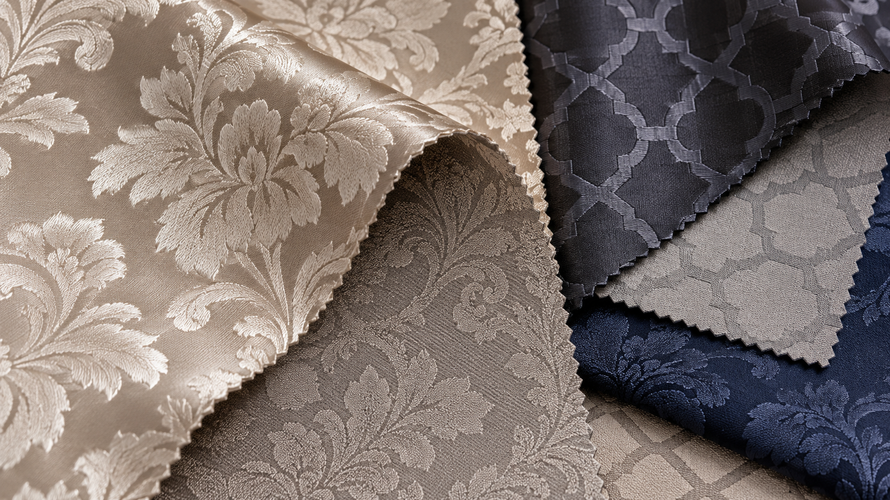
Damask and brocade are both figured woven fabrics, but damask is usually flatter and relies on contrasting weave faces with a reversible or reverse-position effect. Brocade often has a more raised or dimensional appearance and may use supplementary pattern yarns. Both terms are used broadly in trade, so inspect the actual construction.
Jacquard refers to the pattern-control mechanism or woven pattern capability, while damask refers to a particular figured construction and appearance. A printed fabric can imitate a damask motif without having a woven damask structure. Compare the Jacquard fabric guide and the printed, woven and jacquard pattern comparison when a quotation needs to distinguish the route.
What Should Buyers Check in Damask Fabric?
Damask performance depends on the fibre, yarn, density, pattern repeat, finishing and intended use. Check the following properties on a representative piece before approving bulk production.
Pattern Repeat and Reversibility
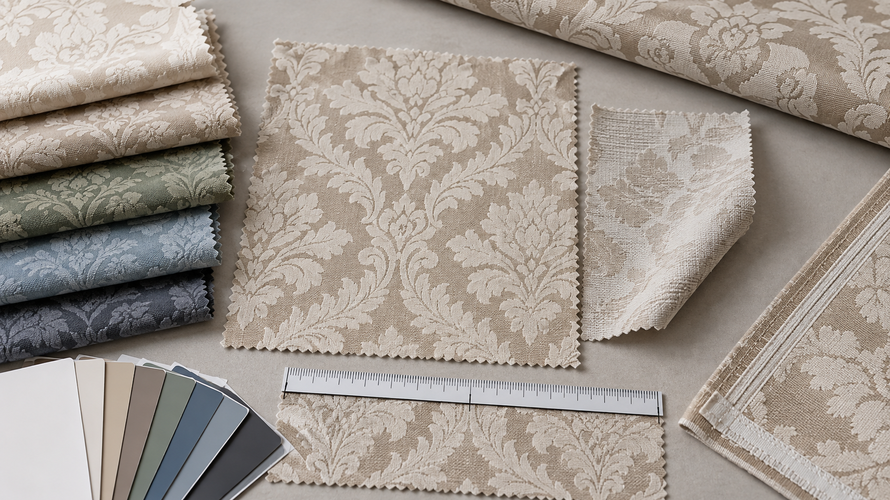
Measure the repeat in both directions and inspect the reverse side. A small swatch may not show how a large motif meets a seam, hem or scarf corner.
Weight, Width and Drape
Record weight and usable width, then hang and fold the finished quality. A furnishing damask and a scarf-weight damask may share a pattern language but behave very differently.
Colour and Light Contrast
Damask contrast comes partly from directional light reflection. Review the fabric from both sides and under the lighting used in the finished setting.
Abrasion, Snagging and Seam Behaviour
Raised yarns, floats, slubs and dense pattern areas can respond differently to rubbing and sewing. Test the actual face, reverse, edge and seam before production.
Care and Dimensional Stability
Measure shrinkage, skew, colour change and surface response after the intended wash, dry-cleaning, steaming or pressing route.
| Buyer check | Why it matters | Possible risk | Evidence to request |
|---|---|---|---|
| Fibre and percentage | Defines labeling and performance direction | Wrong material claim | Specification and fibre disclosure |
| Pattern repeat | Controls cutting and visual continuity | Motif mismatch at seams | Repeat diagram and full-width sample |
| Face and reverse | Confirms the reversible effect | Unexpected contrast or shade | Both-side approval sample |
| Weight and width | Controls use and yield | Finished item lacks body | Measured roll and test report |
| Care and wear | Protects repeat quality and service life | Shrinkage, snagging or colour change | Finished construction test |
Is Damask Suitable for Scarves and Custom Products?
Damask can work for a structured scarf, luxury panel, accessory, lining or interior product when the weight, pattern scale and drape fit the brief. It is less suitable when the product needs a very light, highly fluid or fully opaque result unless the chosen quality has been engineered for that use.
For a custom product, approve the motif at finished scale, inspect both sides, check the cut direction and review the hem or seam. Keep the approved fabric swatch with the artwork and production specification.
How Should Damask Be Specified?
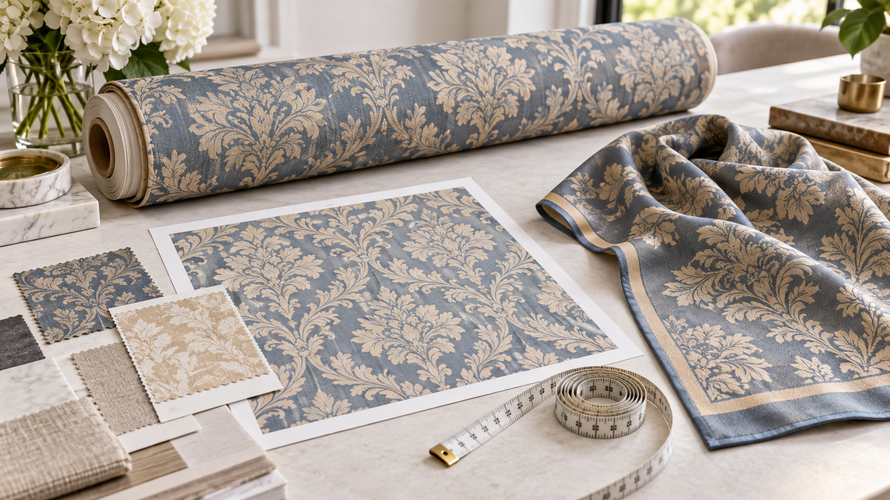
State fibre content and percentage, Jacquard or other construction, weight, usable width, pattern repeat, face and reverse, colour, finish, care route and acceptance tolerances. Use the Jacquard fabric guide for the pattern-control context and the woven fabric guide for warp, weft and construction language.
For colour or printed additions, retain a fabric swatch, repeat diagram and finished-size approval. Do not accept a generic damask label without the fibre, construction and test details.
Frequently Asked Questions
Is Damask Always Made from Silk?
No. Damask can be made from silk, cotton, linen, viscose, blends and other fibres. Confirm the fibre content and percentage in the specification.
Is Damask Reversible?
Classic damask has a pattern that appears in reverse-position form on the other side. The exact contrast and usability of each side depend on the fibre, weave and finish.
Is Damask the Same as Jacquard?
Jacquard describes a pattern-control method or capability, while damask describes a particular figured woven effect. Damask is often made on a Jacquard loom, but not every Jacquard fabric is damask.
How Is Damask Different from Brocade?
Damask is usually flatter and uses contrasting weave faces for the pattern, while brocade often has a more raised or dimensional pattern effect. Trade usage varies, so inspect the actual construction and reverse.
Is Damask Good for Scarves?
It can suit a structured or luxury scarf when the weight, pattern scale, hand, drape and edge are appropriate. A furnishing-weight damask may be too firm, so approve the finished quality.
Can Damask Be Printed?
Damask is already patterned through weaving, but a damask base can also be printed or overdyed. Test how the added colour interacts with the weave contrast and reverse side.
What Should a Damask Supplier Provide?
Ask for fibre content, construction, weight, width, repeat, face and reverse, finish, care route, colour approval and a production-representative sample.
Conclusion
Damask is a woven pattern family valued for reversible contrast and decorative detail. It may be made in silk, cotton, linen, viscose or blends. Specify the fibre, construction, repeat, weight, face, reverse, finish and care route, then approve a representative finished sample.