
Why Do Flight Attendants Wear Scarves? Uniform, Branding and Buyer Checks

Carina Silk Editorial Team writes practical guides on silk fabrics, scarves and custom textile development, with a focus on materials, artwork, sampling, construction and finishing decisions.
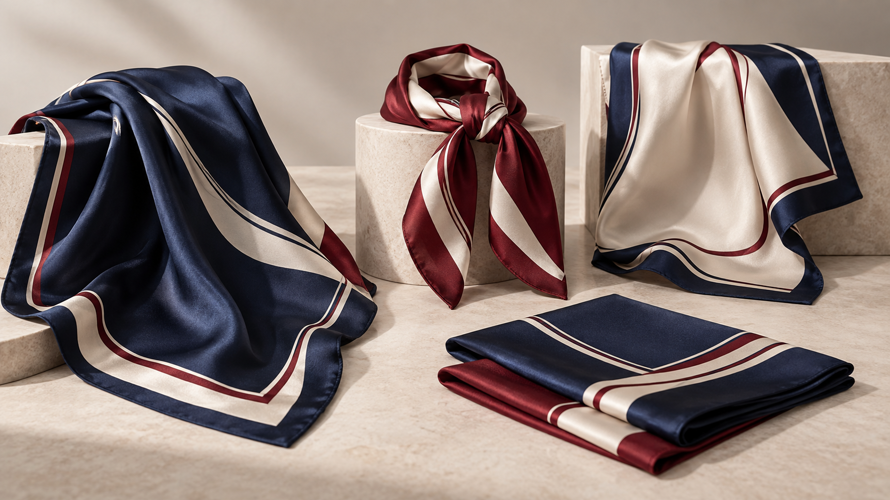
Flight attendants wear scarves because the accessory can combine visual identity, colour coding, polished presentation and repeatable styling within a uniform system. The reason is not one universal rule for every airline. Uniform standards, national traditions, brand language and operational needs vary.
The Association of Flight Attendants uniform reference illustrates why fabric composition and production standards matter in uniform garments, while the public scarf specification example shows how colour, type and crew roles can be written into a procurement document.
Why Do Flight Attendants Wear Scarves?
A scarf can provide a visible finishing element that links a uniform to an airline or hospitality brand. A consistent colour, motif, knot or border can make a large team appear visually coordinated.
Scarves can also support styling flexibility. A square or rectangular format can be tied in an approved way, while the fabric and edge need to remain comfortable, presentable and consistent through repeated use.
The accessory is only effective when the textile system works. Silk may support a luxury image, while a polyester or blend may be selected for care, repeatability, colour and operational use. The final choice is a product decision, not a fibre slogan.
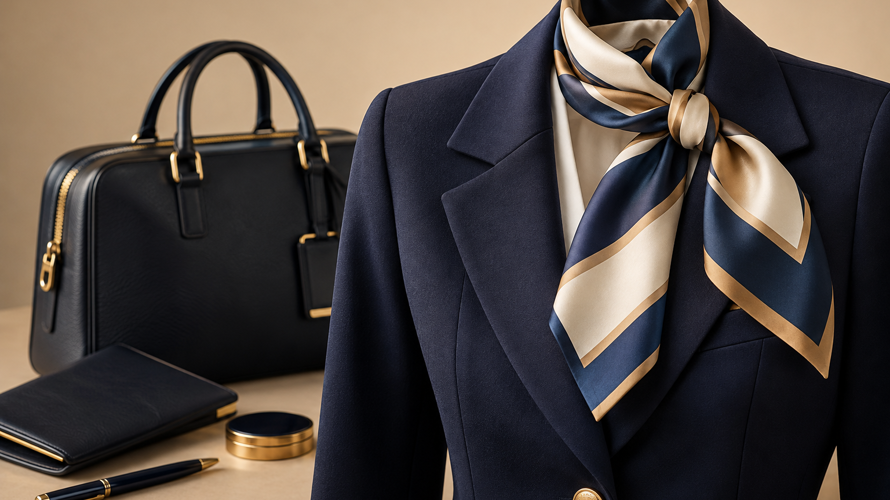
How Is an Airline Scarf Developed?
Start with brand identity, uniform colours, wearer roles, climate, tie method, laundering, number of wearers and replacement cycle. The scarf size and border should be selected with the approved knot or fold.
Develop artwork around the finished shape. A logo or border must remain visible after tying, and the repeat should work across the full size range without awkward crops.
Sample the chosen fabric and compare silk twill, satin or easy-care alternatives for grip, drape, print definition and care. Approve the finished sample in uniform context.
What Types of Airline Scarves Are Used?
The product format should be selected with the tie, uniform and production route in mind.
| Direction | Product character | Potential fit | What to confirm |
|---|---|---|---|
| Square silk scarf | Premium hand and flexible folding | Luxury brand presentation | Slip, care and hem |
| Polyester square scarf | Consistent colour and easier care | High-volume uniform programs | Hand, static and heat |
| Long rectangular scarf | More length for a repeatable tie | Neck or shoulder styling | Length, width and knot bulk |
| Engineered border scarf | Brand border remains visible | Formal uniform identity | Border placement and crop |
| Printed all-over scarf | Repeat covers the full surface | Seasonal or campaign uniforms | Repeat and registration |
| Lightweight easy-care blend | Balanced hand and maintenance | Operational or hospitality use | Composition and recovery |

Uniform Scarf vs Fashion Scarf
A fashion scarf can prioritize novelty, drape or seasonal artwork. A uniform scarf must also support consistency, repeated tying, colour control, care, replacement, wearer comfort and brand recognition.
The custom airline scarf service direction should therefore be briefed with size, tie, fabric, colour, artwork, edge and packaging requirements rather than a reference image alone.
A luxury fibre is not automatically the best operational choice. Compare the finished sample in the actual uniform and care environment.
What Should Airline Scarf Buyers Check?
Uniform accessories need a stricter acceptance basis than a one-off fashion sample.
Brand Colour
Match the approved colour target under relevant lighting and define acceptable lot variation.
Size and Tie
Test the finished size, knot, fold and visibility of the brand motif with the uniform.
Fabric and Care
Record composition, construction, weight, hand, static, snag risk, laundering and pressing limits.
Artwork and Border
Approve logo, motif, repeat, border, reverse, registration and crop on the real scarf shape.
Edge and Seams
Check rolled or folded hem, corner shape, label, seam security and repeated handling.
Packaging and Replacement
Define individual packing, batch identification, spare ratio and the retained standard for future replenishment.
| Check | Why it matters | Possible risk | Evidence to request |
|---|---|---|---|
| Colour | Protects brand identity | Lot variation | Colour standard |
| Tie and size | Controls presentation | Motif hidden or knot bulky | Worn sample |
| Fabric | Controls comfort and care | Hard to maintain | Composition and care test |
| Artwork | Controls recognition | Logo cropped or misregistered | Strike-off |
| Edge | Controls repeat use | Curling or fray | Hem sample |
| Packing | Controls distribution | Pieces mixed or damaged | Packing specification |

Where Else Are Uniform Scarves Used?
The same product logic applies to hotels, cruise lines, rail services, luxury retail, museums, banks, events and other front-of-house teams. The scarf can signal role, colour group or brand identity.
For each program, define whether the product is a head wrap, neck scarf, square scarf or engineered accessory.
The most reliable program is developed as part of the uniform system, with approved tying, fabric, artwork, care and replenishment controls.

How Should an Airline Scarf Be Specified?
State user role, shape, finished dimensions, fabric composition and construction, weight, colour, artwork, logo position, border, hem, tie method, care, packaging, tolerance and replenishment standard.
Attach the uniform artwork layout, a worn sample and a retained finished swatch. Do not approve a flat artwork file alone.
Frequently Asked Questions
Why do flight attendants wear scarves?
Scarves can support brand identity, colour coordination, polished presentation and repeatable uniform styling. The exact reason varies by airline and uniform system.
What fabric is used for flight attendant scarves?
Airlines may use silk, polyester, blends or other fabrics depending on image, care, cost, comfort and operational requirements.
What size is an airline scarf?
There is no universal size. The right dimensions depend on the approved tie, uniform, motif visibility and wearer comfort.
Are flight attendant scarves always silk?
No. Silk may suit a luxury direction, but easy-care polyester or blends may be selected for operational reasons.
How are airline scarf designs developed?
Start with brand colours and the wearing method, then map the artwork to the finished shape and approve fabric, print, edge and worn samples.
What should a uniform scarf buyer test?
Test colour, size, tie, grip, care, print registration, hem, comfort, packaging and replenishment consistency.
Can a supplier make custom airline scarves?
Yes, a supplier can develop custom shape, fabric, artwork, colour, finishing and packaging when the technical brief and sample approval are clear.
Conclusion
A flight attendant scarf is a small but visible part of a larger uniform system. Its success depends on brand colour, finished shape, tie method, fabric, care, artwork, edge and repeatable production.
