What Is Twill Fabric? Structure, Types, Uses and Buyer Checks

Carina Silk Editorial Team writes practical guides on silk fabrics, scarves and custom textile development, with a focus on materials, artwork, sampling, construction and finishing decisions.
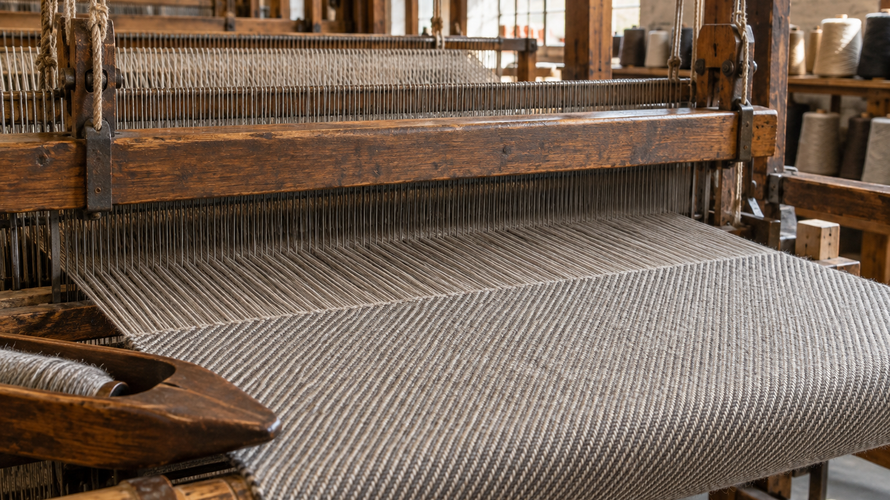
Twill is a woven construction recognised by diagonal ribs or lines on the fabric surface. The diagonal effect comes from the way warp and weft yarns interlace and advance across the repeat; it does not identify a single fibre. Cotton, wool, silk, polyester, viscose and blends can all be made into twill.
For a buyer, the useful question is not simply whether a fabric is twill. Confirm the fibre, yarn, repeat, weight, width, face and reverse, finish, colourfastness, dimensional stability and intended use together.
What Is Twill Fabric?
Twill is a family of woven fabrics in which the interlacing pattern creates a visible diagonal line, ridge or wale. The direction may run from lower left to upper right or the opposite way, depending on the weave draft and fabric construction. The CottonWorks guide to basic woven designs identifies the diagonal pattern as the key visual feature of twill.
Twill describes construction rather than fibre. A silk twill scarf, a cotton workwear twill and a polyester furnishing twill may share the diagonal principle while differing greatly in weight, lustre, softness, recovery and care. For the warp-and-weft vocabulary, see the National Park Service weaving glossary.
How Is Twill Made?
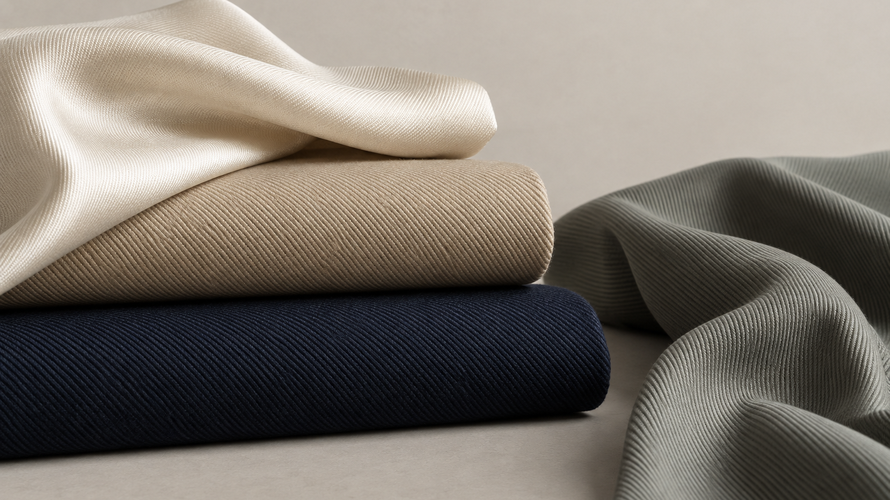
Woven cloth uses lengthwise warp yarns and crosswise weft yarns. In twill, the interlacing point moves in a planned sequence instead of repeating as a simple over-one, under-one plain weave. That float progression creates the diagonal effect and can give the cloth a more covered surface than a comparable plain weave.
The diagonal may be subtle or pronounced. Yarn size, density, colour contrast, finishing and the balance between warp-facing and weft-facing areas all affect what the eye sees. A brushed or washed finish can soften the line, while a smooth finish can make it more obvious.
The NPS overview of weaving patterns is useful for separating the basic weave families before comparing individual fabrics.
What Are the Main Twill Types?
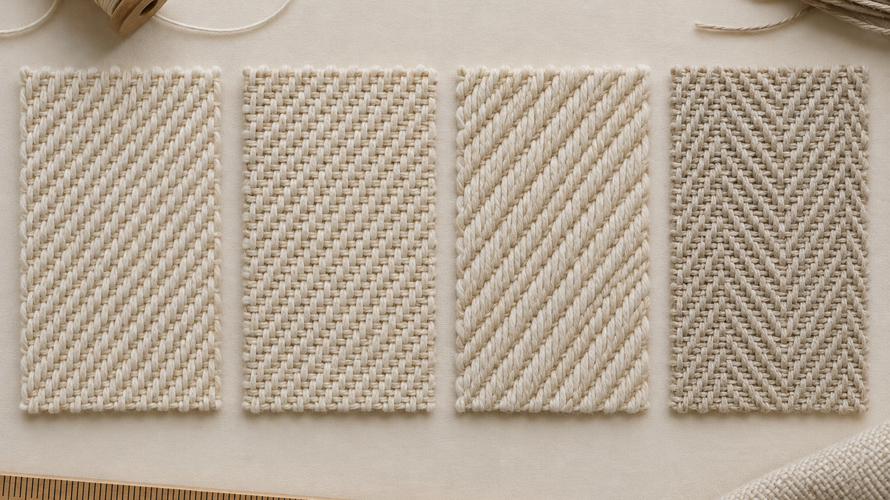
Twill names often refer to the repeat, diagonal direction or end use. The repeat notation describes how many warp and weft yarns are involved in a basic sequence; it does not by itself fix the fibre, weight or final hand.
| Type or direction | Visual or structural idea | Common fit | What to confirm |
|---|---|---|---|
| 2×1 twill | Light, clear diagonal with a simpler repeat | Shirting, light scarves and apparel | Coverage, skew and finished weight |
| 2×2 twill | Balanced repeat with an even face | Medium-weight apparel and accessories | Face, reverse and drape |
| 3×1 twill | More dominant warp or weft face | Denim, workwear and structured goods | Direction, abrasion and shrinkage |
| Herringbone | Reversing diagonals form a broken zigzag | Tailoring, outerwear and decorative panels | Chevron alignment and repeat |
| Gabardine-style twill | Compact diagonal with a firm surface | Structured apparel and uniforms | Density, comfort and care response |
Twill Compared with Plain Weave, Satin and Print
Plain weave repeats a simple over-and-under interlacing and often gives a stable, crisp base. Twill moves the interlacing point to form a diagonal and can offer more surface coverage or drape at a similar yarn size. Satin uses longer floats and is usually smoother and more reflective, but it can be more sensitive to snagging or slippage.
Printing places colour or artwork on the surface; it does not turn a plain weave into a twill. A twill base may be printed, piece-dyed or yarn-dyed. Use the printed, woven and Jacquard pattern comparison when a quotation needs to separate construction from surface design. A silk twill is also distinct from silk satin; compare the relevant sateen versus satin guide for surface terminology.
What Should Buyers Check in Twill Fabric?
Twill is not a performance guarantee. Check the actual construction against the product brief, especially when a scarf, printed panel or garment must hold a specific drape and edge.
Diagonal Direction and Face
Inspect the diagonal under the intended lighting and mark the face used for cutting, printing and presentation. A left-hand and right-hand twill can create a different visual direction.
Drape and Body
Hang and fold a production-representative piece. Fibre, yarn size, density, finish and weight decide whether the twill feels fluid, crisp, dry, soft or structured.
Abrasion and Surface Wear
Test rubbing, snagging and seam movement on the finished face. A compact workwear twill and a smooth silk twill have different wear risks even though both show diagonal lines.
Bias, Skew and Dimensional Stability
Check grain, skew, shrinkage and recovery after the intended wash, steam or pressing route. The diagonal construction can influence how an edge or cut panel behaves on the bias.
Colour, Print and Finish
Confirm whether the design is piece-dyed, yarn-dyed or printed. Record colour under the production lighting and check whether brushing, washing, coating or calendaring changes the diagonal or hand.
| Buyer check | Why it matters | Possible risk | Evidence to request |
|---|---|---|---|
| Fibre and blend | Sets care and performance direction | Wrong label or hand expectation | Fibre specification and test record |
| Repeat and direction | Controls visual line and cutting | Motif or grain mismatch | Construction note and full-width sample |
| Weight and usable width | Controls drape, yield and cost | Finished product lacks body | Measured roll and approved standard |
| Face and reverse | Confirms which side is presented | Unexpected shade or lustre | Both-side approval sample |
| Skew and shrinkage | Protects finished dimensions | Twisted panel or uneven hem | After-care measurement |
| Colour and finish | Protects appearance and hand | Shade drift or altered rib | Strike-off and finish approval |

Is Twill Suitable for Scarves and Custom Products?
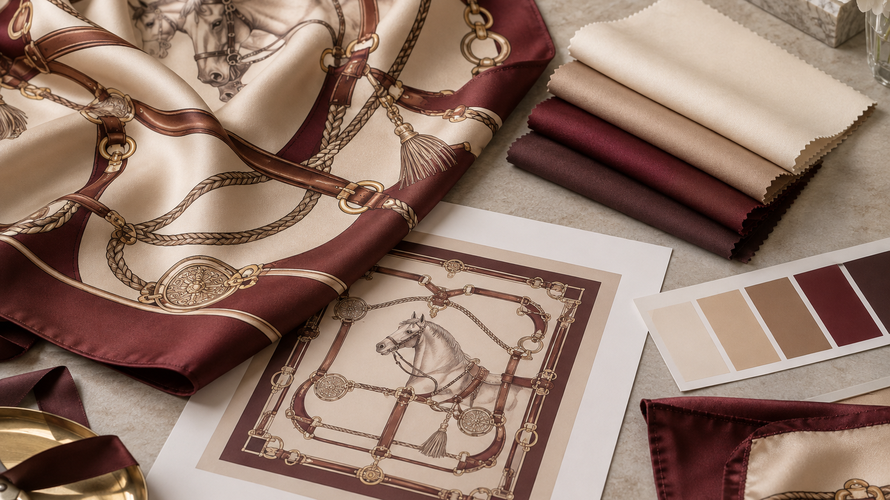
Twill can work for silk scarves, bandanas, apparel panels, uniforms, bags and other products when the weight, edge, coverage and drape fit the brief. A lighter twill can give a printed scarf more body than a very open plain weave, while a compact twill may be too firm for a soft, floating style.
For custom development, approve the artwork at finished scale, confirm the grain and diagonal direction, review the hem, and keep the approved fabric swatch with the colour standard and sample record.
How Should Twill Be Specified?
State the fibre content and percentage, twill repeat, diagonal direction, yarn, weight, usable width, face and reverse, colour, finish, care route and acceptance tolerances. If the material will carry artwork, include the print method, repeat, colour standard, edge treatment and finished dimensions.
Use the woven fabric guide for construction language and the types of silk fabric guide when a silk quality is under consideration. Keep the construction record, approved swatch and finished sample together.
Frequently Asked Questions
Is Twill a Fibre?
No. Twill is a woven construction. It can be made with cotton, wool, silk, polyester, viscose, blends and other fibres.
Does Twill Always Have a Diagonal Line?
Most twill constructions show a diagonal rib or line, but its strength depends on yarn, density, colour contrast and finish. Inspect the actual fabric rather than relying on the name.
Is Twill Stronger Than Plain Weave?
Not automatically. Twill can offer useful coverage and wear performance, but strength depends on fibre, yarn, density, finish and construction. Compare measured samples for the intended use.
Is Twill Good for Silk Scarves?
Silk twill can suit printed scarves when its weight, drape, opacity, surface and hem fit the design. Approve the finished scarf or a production-representative sample.
Does Twill Stretch?
Basic woven twill has limited mechanical stretch, but bias movement, loose construction, elastane or a special finish can change the result. Measure stretch and recovery in the actual direction that matters.
What Is the Difference Between Twill and Satin?
Twill is identified by a diagonal interlacing pattern, while satin is associated with longer floats and a smooth, reflective face. Fibre and finish still need to be confirmed in both cases.
What Should a Twill Supplier Provide?
Request fibre content, repeat and direction, weight, usable width, face and reverse, colour and finish standards, care route, dimensional tests and a representative finished sample.
Conclusion
Twill is a construction family, not a fibre name. The diagonal line can support useful body, drape and wear performance, but the finished result depends on the yarn, density and finish. Approve the actual face, reverse, edge and finished sample before bulk production.