
Types of Silk Fabric: Weaves, Finishes, Uses and Buyer Checks

Carina Silk Editorial Team writes practical guides on silk fabrics, scarves and custom textile development, with a focus on materials, artwork, sampling, construction and finishing decisions.

Silk fabric is made from silk fibre, but silk is not one universal fabric construction. The same fibre family can be woven into a smooth satin, a diagonal twill, a sheer chiffon, a pebbled crepe or a crisp plain weave. Yarn, weight, weave, finishing and printing all change the result.
For a buyer, the useful question is not simply “which silk is best?” It is which silk construction provides the required hand, drape, opacity, surface, print result, edge stability and care route for the finished product.
What Is Silk Fabric?
Silk is a natural protein fibre, while silk fabric is the finished textile made from silk yarn through weaving, knitting or another construction route. The FTC textile labeling guidance and its Textile Fiber Rule treat silk as a generic fibre name that must be used accurately in fibre-content disclosures.
“Silk satin” describes a silk fabric with a satin construction or surface direction; it does not describe a separate fibre. The same principle applies to silk twill, silk chiffon, silk crepe and silk organza. Always record fibre, construction, weight and finish together.

What Are the Main Types of Silk Fabric?
The most useful silk taxonomy starts with construction and finished surface. Satin and twill are weave directions; chiffon, crepe, organza and velvet describe specific structures or surface effects that can be made in different fibres. The table is a starting point, not a substitute for the actual sample.
| Silk fabric type | Surface and hand | Drape or body | Common use | Confirm before buying |
|---|---|---|---|---|
| Silk twill | Defined diagonal texture | Moderate body and controlled drape | Printed scarves and accessories | Weight, face, print and hem |
| Silk satin | Smooth and reflective | Fluid, sometimes slippery | Luxury accessories and occasionwear | Slip, snagging and care |
| Silk chiffon | Light, airy and sheer | Soft movement with little body | Layered scarves and formal goods | Opacity, seam and edge |
| Silk crepe | Fine pebbled or matte face | Fluid with more visual texture | Dresses, blouses and scarves | Crepe scale, weight and print |
| Silk habotai | Smooth plain weave | Light and flexible | Linings, painting and light scarves | Weight, opacity and tear strength |
| Silk organza | Crisp and transparent | Structured and springy | Layering, trims and formal details | Transparency and seam handling |
| Silk dupioni | Visible slub texture | Crisp with body | Structured apparel and décor | Slub tolerance and colour variation |
Silk Twill, Satin and Plain Weave
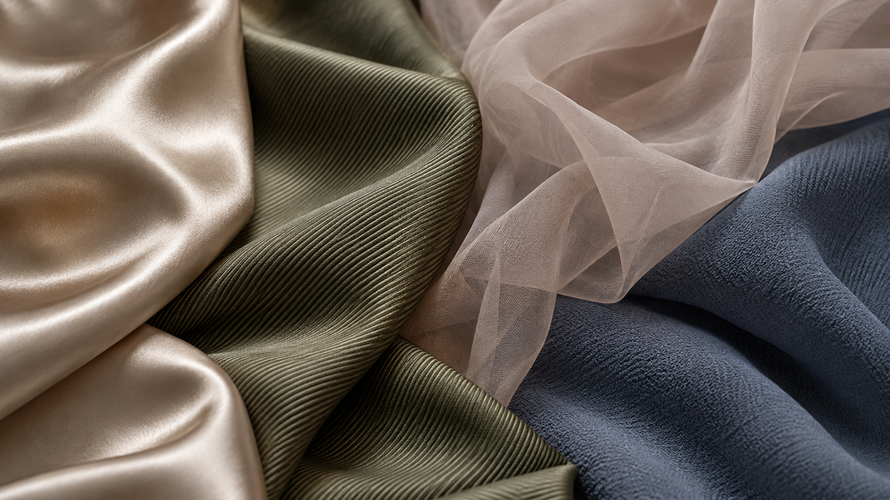
Silk twill has a recognisable diagonal rib and usually gives a more defined hand than a very light plain weave. Silk satin has a smooth face and stronger surface reflection, but it can move or snag more readily. A plain-weave silk such as habotai can feel light, flexible and less visibly lustrous.
These names describe construction or surface direction, not a guaranteed weight. Two suppliers can use the same name for qualities with different yarn size, density, finishing and opacity. A satin versus sateen comparison is useful when a specification needs to separate silk satin from cotton or other fibre constructions.
Silk Chiffon, Crepe, Organza and Velvet
Silk chiffon is light and transparent, so it is often selected for airy layers or formal styling. Silk crepe has a textured or pebbled face and can provide a more matte visual direction. Silk organza is crisp and sheer, while silk velvet has a pile that changes the hand and light response significantly.
These fabrics need different checks. Chiffon needs an opacity and edge review; organza needs a seam and crease review; velvet needs pile direction and shading checks. The product name alone cannot replace a construction sample.
What Properties Should You Compare?
Compare properties against the end use rather than selecting a type from a generic ranking. For a printed scarf, surface, colour, drape, opacity and hem stability may matter most. For a lining, slip, abrasion and seam movement may be more important.
Hand and Drape
Hang, fold, knot and handle the finished sample. A flat swatch can hide how the full-size fabric falls, twists and recovers.
Opacity and Light Response
Chiffon and organza need a direct opacity check, while satin and velvet can change appearance under directional light. Review the sample in the lighting used by the customer.
Colour and Print
Silk surface, ground colour, weave and print method influence the final appearance. Approve a strike-off at the intended scale, then check the finished-size piece and edge treatment.
Care and Dimensional Change
Confirm the care route for the exact silk construction. Measure shrinkage, skew, colour change, water marks and pressing response after the intended process.
Edge, Seam and Snagging Risk
Light and slippery silks can need careful cutting, hemming and seam control. Test the finished edge, not just the centre of the fabric, and consider contact with pins, hardware and rough surfaces.
| Check | Why it matters | Risk if skipped | Suggested evidence |
|---|---|---|---|
| Weight and width | Controls body, yield and finished size | Sample does not match production brief | Measured roll and approved sample |
| Hand and drape | Controls styling and customer perception | Flat swatch gives a false impression | Full-size handling review |
| Opacity and light | Important for sheer and reflective surfaces | Unexpected transparency or shine | Lighting and layering check |
| Colour and fastness | Protects artwork and repeat orders | Shade or care complaints | Strike-off and relevant fastness test |
| Edge and care | Protects finished appearance | Fraying, water marks or distortion | Hemmed sample and care test |

Which Silk Fabric Is Best for Custom Scarves?
There is no universal best silk fabric. Silk twill often suits a defined printed scarf with controlled drape; silk satin suits a smoother reflective luxury direction; chiffon suits airy layering; and a light plain weave can suit a soft, flexible accessory. The decision depends on finished weight, width, opacity, print, edge and care.
For custom development, approve the artwork on the proposed fabric, inspect the full-size printed piece, and test the hem. A beautiful small swatch can still fail if the production width, repeat scale or edge behaviour is wrong.

How Should Buyers Specify Silk Fabric?
State silk fibre content, construction or weave, weight or momme where appropriate, width, face, reverse, hand, drape, opacity, finish, print method, repeat, colour target, care route and edge treatment. Keep the approved fabric swatch with the purchase specification.
If the fabric is woven, use the woven fabric guide to record warp, weft and density. For print decisions, compare the printed, woven and jacquard pattern routes before approving artwork.
Frequently Asked Questions
What Is the Softest Silk Fabric?
Softness depends on silk type, yarn, weight and finishing. A smooth satin, fine habotai or fluid crepe may feel soft, but the finished sample is more reliable than the name alone.
What Is the Difference Between Silk Satin and Silk Twill?
Silk satin has a smooth reflective face and fluid movement, while silk twill has a diagonal rib and usually a more defined hand. Weight, density and finishing can change both behaviours.
Is Chiffon Always Made from Silk?
No. Chiffon describes a light, sheer fabric direction and can be made from silk, polyester or other fibres. Confirm the fibre content instead of assuming chiffon means silk.
Does Silk Fabric Stretch?
Most basic woven silks have limited mechanical stretch, while bias movement, loose constructions, knits or elastane blends can change the result. Test stretch and recovery on the finished quality.
Is Silk Good for Printed Scarves?
Silk can be excellent for printed scarves, but the best construction depends on the desired hand, drape, opacity, surface, colour and budget. Approve a strike-off and full-size finished sample.
Does Silk Shrink?
Silk can change dimension through wet processing, heat and finishing, but the amount varies by construction and care route. Measure the exact quality after the intended process.
What Should a Silk Supplier Provide?
Ask for fibre content, construction, weight, width, finish, colour or print evidence, care route, testing and a production-representative sample with the finished edge.
Conclusion
The best silk fabric depends on the final product. Separate silk fibre from weave, surface and finish, then compare weight, drape, opacity, print, care and edge behaviour on a production-representative sample before approval.
