Does Linen Shrink? Causes, Care and Buyer Checks

Carina Silk Editorial Team writes practical guides on silk fabrics, scarves and custom textile development, with a focus on materials, artwork, sampling, construction and finishing decisions.
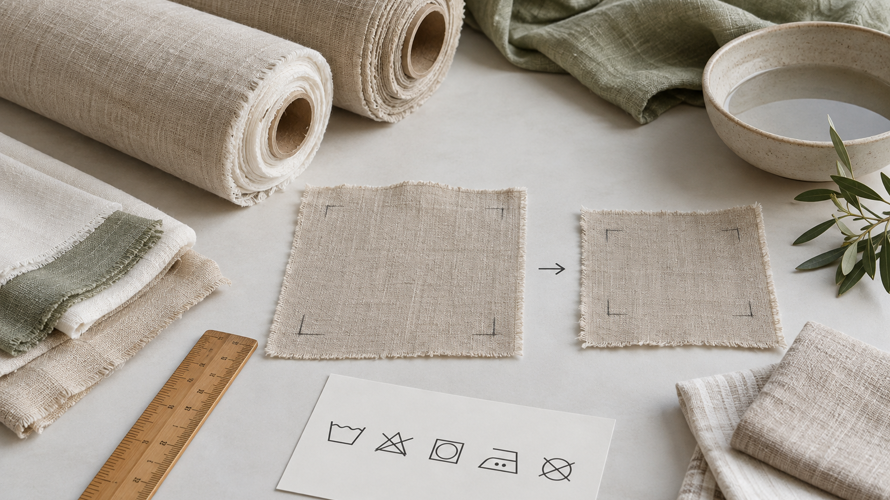
Linen can shrink or relax, especially during the first wet treatment. The amount is not universal: it depends on fibre preparation, yarn, weave, finishing, prewashing and the washing and drying route. A linen shrinkage guide makes the same practical point: a small sample wash is safer than relying on a generic percentage.
For B2B sourcing, shrinkage is a dimensional-control issue. Confirm usable width, finished length, skew, print placement and care instructions before cutting or approving a bulk order.
Can Linen Shrink?
Linen shrinkage is dimensional change after wet processing, washing, drying, pressing or relaxation. It may affect length, width, skew, edge movement or the position of a print and hem.
Prewashed or stonewashed linen may have already experienced part of its expected change, but the treatment does not remove the need for a defined test.
A linen and cotton comparison can explain broad fibre differences, but it cannot replace the exact fabric specification and care trial.

Why Does Linen Shrink?
Moisture can relax stresses introduced during spinning, weaving, dyeing and finishing. Heat, agitation and tumble drying can increase movement compared with gentle washing and air drying.
A loose or open construction may move differently from a dense one. Finishing can improve stability or deliberately create a washed character, but the result must be checked on the delivered quality.
Printing, cutting and hemming can reveal changes that are less obvious on a loose swatch. Test the finished route when the product is a scarf, garment or home textile.
Which Linen Qualities Need Different Shrinkage Checks?
Classify the actual quality before setting a tolerance.
| Direction | Textile character | Potential fit | What to confirm |
|---|---|---|---|
| Unwashed linen | More initial relaxation possible | Natural-look apparel and accessories | Prewash route and width |
| Prewashed linen | Some change already controlled | Cut-and-sew products | Residual change and label |
| Stonewashed linen | Softened and intentionally relaxed | Casual and textured products | Finish consistency |
| Linen blend | Other fibre changes movement | Cost or performance balance | Blend ratio and care |
| Printed linen | Ground and artwork move together | Scarves and fashion panels | Strike-off after care |
| Open linen weave | More air and possible edge movement | Lightweight summer products | Skew, fray and opacity |

Linen Shrinkage vs Linen Quality
A lower shrinkage result is not automatically a better linen. Some products need a washed, relaxed character; others need tight dimensional control for borders, repeat placement or precise cutting.
Use the GSM and weight guide with width, weave and finishing information. Weight alone cannot predict how a particular linen will move.
The buyer should approve the care route and the finished dimensions together, not approve an unwashed roll and decide care later.
What Should Buyers Check Before Ordering Linen?
Set the test conditions before discussing a shrinkage number.
Fibre and Blend
Confirm linen percentage and every blended component because blend structure affects movement.
Construction and Finish
Record weave, yarn, weight, width, prewash, stonewash and other finishing steps.
Starting Condition
Condition the sample and mark length and width points before treatment.
Care Route
Test the actual wash, temperature, agitation, drying and pressing method used by the customer.
Dimensional Result
Record length, width, skew, spirality, edge movement and print or border position.
Finished Product
Check the cut, hem, label and packaging because the final product may behave differently from the roll.
| Check | Why it matters | Possible risk | Evidence to request |
|---|---|---|---|
| Prewash status | Sets expectations | Residual change missed | Finish record |
| Width | Controls yield and layout | Border or pattern crop | Usable width |
| Care route | Makes result repeatable | Uncontrolled change | Wash and dry method |
| Measurements | Shows where movement occurs | Skew missed | Before-after record |
| Tolerance | Sets acceptance | Delivery dispute | Agreed range |
| Finished sample | Confirms reality | Roll misleads | Approved product |

Where Is Linen Used?
Linen is used in apparel, scarves, home textiles, interiors and lightweight summer products where texture, air movement and a natural hand are useful.
For a custom printed scarf, compare linen with silk or rayon by drape, opacity, print response, crease behaviour, edge and care.
A linen product can be intentionally relaxed, but the intended character should be documented and approved.

How Should Linen Shrinkage Be Specified?
State fibre and blend, weave, weight, width, prewash or stonewash status, care route, test method, length and width tolerance, skew, print position and finished dimensions.
Attach a finished swatch and a before-and-after record. For a printed or hemmed scarf, include a finished sample after the agreed care test.
Frequently Asked Questions
Does linen shrink?
Linen can shrink or relax, especially during the first wet treatment. The result depends on construction, finish and care.
How much does linen shrink?
There is no universal percentage for every linen. Test the exact quality under the intended wash and drying route.
Does prewashed linen still shrink?
It may show less additional change, but residual movement is still possible and should be measured.
Does linen shrink in hot water?
Heat and agitation can increase dimensional change. Follow the tested care route for the specific fabric.
Can linen shrink in the dryer?
Tumble drying can increase movement compared with gentle air drying, depending on temperature and construction.
Is linen good for scarves?
It can suit scarves when the intended texture, weight, crease behaviour, print, edge and care are acceptable.
What should a linen buyer request?
Request fibre, construction, prewash status, width, test method, dimensional tolerance and a finished reference sample.
Conclusion
Linen shrinkage is a property of the exact finished quality and care route. Confirm prewash status, construction, measurements, tolerance and finished-product behaviour before cutting or bulk approval. Use a fabric swatch and a controlled care trial as the approval evidence.