
What Is Crinkle Fabric? Structure, Types, Uses and Buyer Checks

Carina Silk Editorial Team writes practical guides on silk fabrics, scarves and custom textile development, with a focus on materials, artwork, sampling, construction and finishing decisions.

Crinkle fabric is a textile with an intentionally irregular, rippled, puckered or crushed surface. The crinkle effect may come from yarn, weave, knitting, heat, mechanical action, chemical treatment or finishing, so the name does not identify one fibre or one fixed performance level.
For a buyer, the key question is whether the texture is stable on the finished product. Fibre content, construction, texture depth, recovery, weight, width and care route determine whether a crinkle fabric keeps its character after printing, cutting, washing and hemming.
What Is Crinkle Fabric?
Crinkle fabric describes a surface direction, not a single material. A crinkled textile can be made from silk, viscose, cotton, polyester or a blend. The Textile Exchange materials classification is useful for separating the fibre family from the finished fabric description.
Some qualities are created through yarn or construction, while others are textured after the cloth is formed. The resulting surface can be light and airy, softly puckered, sharply pleated or irregularly crushed. It should be described with the base fibre and construction rather than with the word crinkle alone.
The crêpe fabric guide shows a related principle: surface character can come from yarn and construction, and a similar visual effect does not guarantee the same hand or drape.
How Is Crinkle Fabric Made?
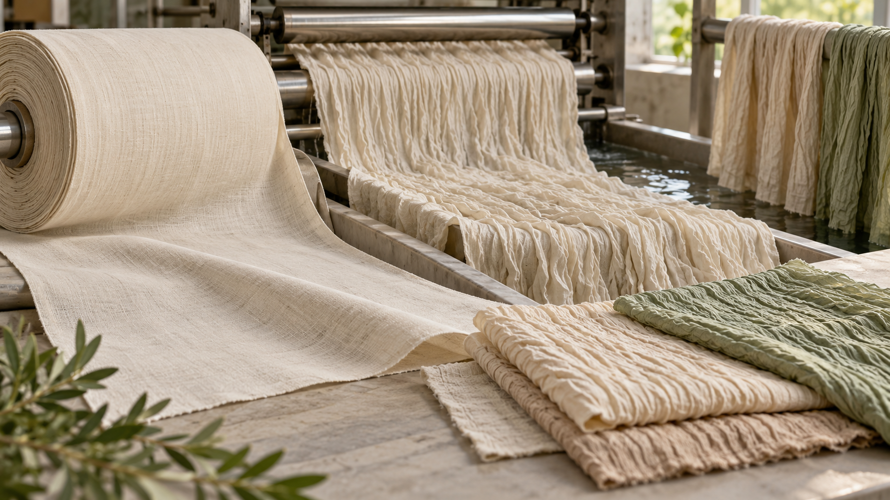
A crinkle effect can begin with high-twist yarn, differential shrinkage, a textured knit, a deliberately uneven construction or a post-weave finishing route. The chosen route controls whether the texture is built into the structure or added after the cloth is made.
Heat, pressure, moisture and finishing can set or exaggerate the surface. Some treatments create a relatively stable texture, while others relax with wear, pressing or laundering. The same nominal crinkle direction can therefore produce very different finished results.
For a printed scarf or accessory, check how the surface changes artwork scale, registration, border alignment and edge behaviour. A smooth artwork file should be reviewed on the final crinkled base, not only on a flat digital preview.
What Are the Main Crinkle Fabric Directions?
The most useful way to compare crinkle fabrics is by the source of the texture and the stability expected in the finished product.
| Direction | Surface character | Potential fit | What to confirm |
|---|---|---|---|
| Yarn-textured crinkle | Texture begins in yarn or differential shrinkage | Soft scarves and flowing apparel | Texture recovery and width |
| Woven crinkle | Stable or semi-stable puckered structure | Light woven products and accessories | Warp, weft and edge stability |
| Knit crinkle | Flexible texture with possible stretch | Casualwear and close-to-skin products | Stretch, recovery and spirality |
| Finished or crushed crinkle | Surface is developed after construction | Fashion effects and decorative textiles | Treatment durability and care limits |
| Silk or silk-blend crinkle | Light hand with fibre-specific lustre | Scarves and refined accessories | Fibre ratio, print route and snag risk |
| Synthetic crinkle | Often consistent and easy-care oriented | Cost-sensitive or repeatable programs | Heat response, static and surface change |

Crinkle Fabric vs Smooth Fabric: What Changes?
Crinkle fabric can disguise small handling marks and create visual depth, while a smooth fabric usually gives more predictable artwork placement and a cleaner surface. Neither direction is automatically better. The choice depends on the required look, drape, opacity, care and finished dimensions.
A textured surface can reduce the visual sharpness of fine lines or alter a border after relaxation. A smooth base may make placement easier but can show creases, snags or surface marks more clearly. Use a fabric swatch and finished sample workflow to judge the actual product.
When the brief needs a defined woven body, compare the texture with a woven fabric guide and confirm whether the crinkle effect is part of the structure or a reversible finish.
What Should Buyers Check in Crinkle Fabric?
The surface is the selling point, but it is also the main source of specification risk. Record the texture and its acceptable change before bulk production.
Fibre and Construction
Confirm fibre content, yarn route, knit or weave, weight, width and whether the texture is structural or finish-created.
Texture Depth and Recovery
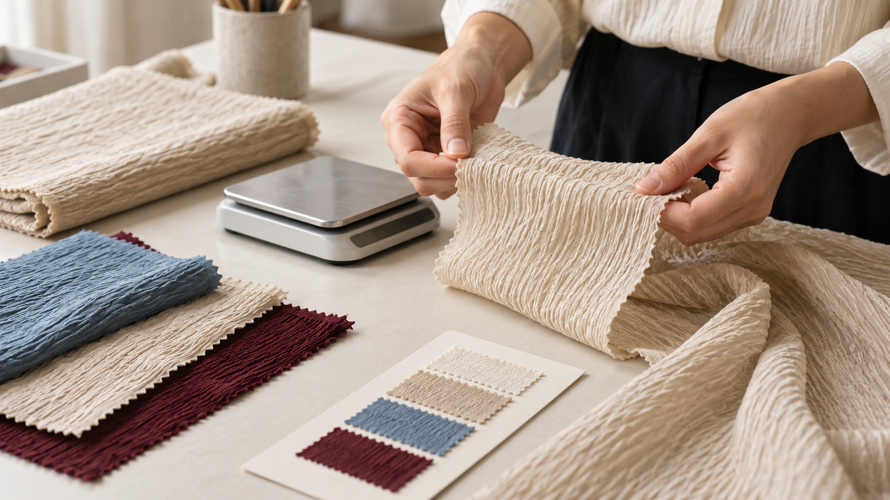
Measure or describe the relaxed texture, then check how it returns after folding, hanging, steaming and the intended care route.
Artwork and Placement
Review repeat, borders, fine lines and colour on the textured surface. Confirm whether the artwork follows the relaxed or finished dimension.
Shrinkage and Skew
Record length, width, skew and texture change before and after the relevant wash or conditioning test.
Edge and Hem
Check fraying, curling, distortion and hem allowance because texture can change the finished edge more than a flat swatch suggests.
Care and Packing
Confirm whether pressing, compression or heat can flatten the texture, and pack the approved reference so it can be compared later.
| Check | Why it matters | Possible risk | Evidence to request |
|---|---|---|---|
| Texture source | Defines expected stability | Surface relaxes or flattens | Construction or finishing note |
| Weight and width | Controls yield and drape | Wrong coverage or costing | Finished measurement |
| Artwork | Controls visual alignment | Border or repeat distortion | Strike-off on final base |
| Care | Protects surface character | Heat damage or flattening | Care trial |
| Dimensions | Controls finished fit | Shrinkage or skew | Before-and-after record |
| Edge finish | Controls product appearance | Curling or uneven hem | Finished sample |
What Is Crinkle Fabric Used For?
Crinkle fabrics are used for scarves, shawls, dresses, blouses, skirts, overlays, relaxed home textiles and decorative accessories. Light crinkle constructions can create movement without relying on a heavy fabric.
For scarf development, compare texture with the georgette fabric guide because both may be selected for a light, flowing direction while behaving differently in opacity, surface and print response.
Choose crinkle when its texture supports the visual brief and care route. Do not promise a permanent effect until the exact fabric and finishing process have been tested.
How Should Crinkle Fabric Be Specified?
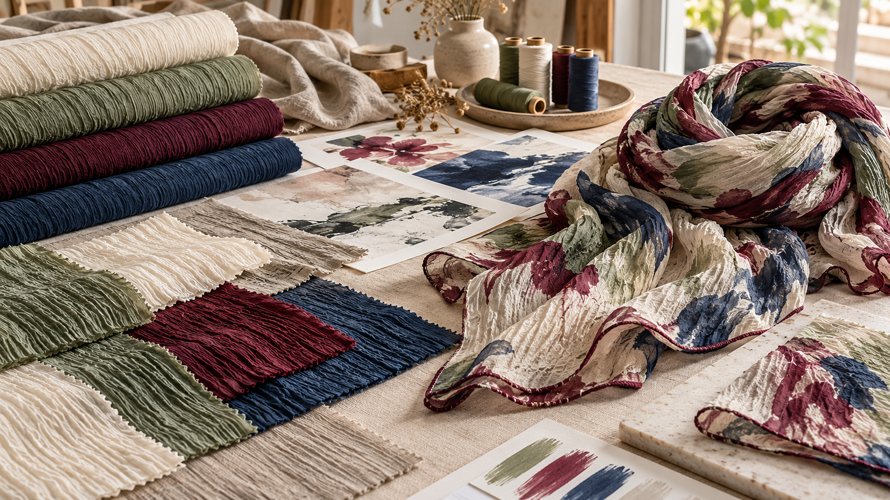
State fibre content, construction, texture source, relaxed and finished width, weight, opacity, colour, print route, texture tolerance, shrinkage, skew, care and edge finish.
Attach a reference swatch and define whether the approved texture is measured before or after finishing. For a custom printed product, include artwork scale, border placement and the finished sample as part of acceptance.
Frequently Asked Questions
What is crinkle fabric?
Crinkle fabric is a textile with an intentionally rippled, puckered, pleated or crushed surface. It can be made from different fibres and constructions.
Is crinkle fabric a type of fibre?
No. Crinkle describes the surface or construction direction. The actual fibre may be silk, viscose, cotton, polyester or a blend.
Does crinkle fabric stay wrinkled?
Some crinkle qualities are designed to retain their texture, while others relax with heat, pressure, washing or wear. Confirm the exact finished quality.
Can crinkle fabric be printed?
Yes, but texture can change repeat, border alignment and fine detail. Approve a printed strike-off on the actual crinkle base.
Does crinkle fabric need ironing?
Care depends on how the texture is created. High heat or pressing may flatten or damage some crinkle finishes, so follow the tested care route.
Is crinkle fabric good for scarves?
It can suit scarves when the required texture, opacity, drape, print response and edge finish are confirmed on a finished sample.
What should a buyer request for crinkle fabric?
Request fibre content, construction, weight, width, texture reference, care route, dimensional test, print sample and finished hem sample.
Conclusion
Crinkle fabric is best specified as a combination of fibre, construction, texture source and finished behaviour. Confirm texture recovery, dimensions, artwork placement, care and edge treatment on the exact sample before approving bulk production.
