What Is Sublimation Printing? Process, Fabrics and Buyer Checks

Carina Silk Editorial Team writes practical guides on silk fabrics, scarves and custom textile development, with a focus on materials, artwork, sampling, construction and finishing decisions.

Sublimation printing is a heat-based dye transfer method used most commonly with polyester textiles and other polymer-coated substrates. It can produce detailed artwork and colour gradients without leaving a thick ink layer on the surface.
The print result depends on the substrate, dye, transfer paper, temperature, pressure, time, artwork and finishing. A successful file or transfer sheet does not replace approval of the finished fabric.
What Is Sublimation Printing?
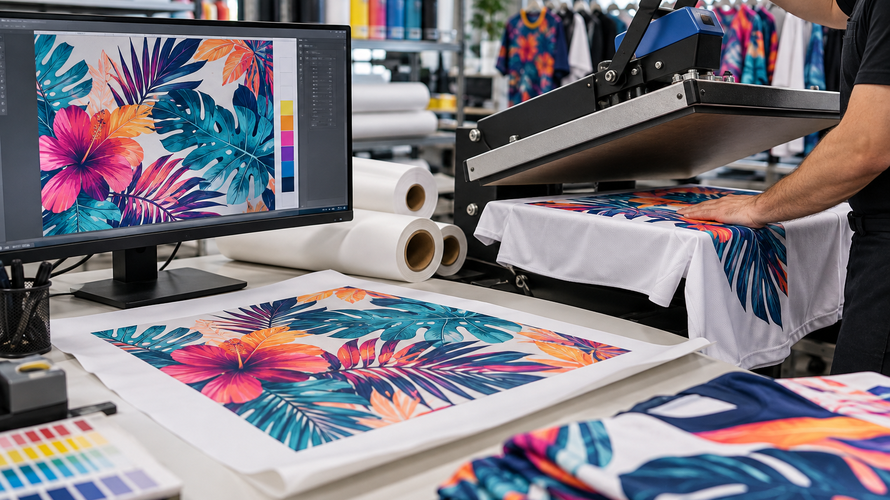
In textile dye sublimation, a design is printed with dye-based inks onto transfer paper and then transferred into a compatible polymer surface by heat and pressure. The dye changes state and migrates into the substrate rather than forming a conventional surface film.
The Printing Industries of America overview explains the process family and why polyester is widely used. On a textile project, composition and surface finish still need to be checked on the exact fabric.
Sublimation should not be confused with every printed, woven and Jacquard pattern route. The construction and the surface-decoration method are separate parts of the specification.
How Does Textile Sublimation Printing Work?
The artwork is prepared for the finished size, repeat, colour profile and print direction. It is printed in reverse onto transfer paper with suitable dye-sublimation inks.
The paper is placed against a polyester-rich or polymer-coated substrate. Controlled heat and pressure allow the dye to migrate into the polymer surface. The textile then returns to its intended hand without a heavy raised print film.
Calendering, heat setting, washing, cutting and hemming can change the visual result. Check colour, registration, repeat, edge behaviour and hand on a production-scale sample.
What Fabrics Can Be Used for Sublimation Printing?
Compatibility is determined by the polymer content or coating and by the fabric construction. The following directions need sample confirmation before they are treated as interchangeable.
| Substrate direction | Typical result | Common fit | What to confirm |
|---|---|---|---|
| Polyester woven | Stable printed surface with controlled detail | Scarves, flags and apparel panels | Fibre content, width and colour |
| Polyester knit | Flexible surface with possible stretch | Sportswear and soft accessories | Stretch, recovery and bleed |
| Polyester satin | Smooth reflective surface | Decorative and premium-looking products | Reflection, slip and print density |
| Polyester chiffon | Light and potentially sheer | Airy scarves and overlays | Opacity, show-through and edge |
| Polymer-coated textile | Transfer depends on coating | Specialty products | Coating compatibility and cure |
| Polyester blend | Result may be softer or more muted | Cost or hand-led products | Blend ratio and wash change |

Sublimation Printing vs Other Textile Printing Methods
Sublimation transfers dye into a compatible polymer surface. Direct digital pigment, reactive or acid printing routes use different inks, pre-treatment and fibre requirements. The fabric pattern guide is useful when the buyer needs to distinguish artwork from construction.
A fabric swatch and finished sample should show the chosen method on the real base. A method that works on polyester may not produce the same result on silk, cotton or a low-polyester blend.
Select the method for fibre compatibility, hand, colour, wash performance, artwork, quantity and product use rather than choosing a process only because it supports a colourful file.
What Should Buyers Check Before Sublimation Production?
The transfer method is only one part of the production brief. Lock the substrate and the finished product checks before approving bulk.
Fibre and Substrate
Confirm polyester content, coating, construction, weight, width, stretch and surface before preparing the final artwork.
Artwork and Repeat
Check file size, colour space, mirror direction, repeat, border, placement, bleed and the finished cut dimensions.
Colour and Detail
Approve a strike-off for colour, gradients, fine lines, dark areas, skin tones or brand colours under the final lighting.
Heat and Hand
Check whether heat changes lustre, shrinkage, skew, softness, stretch recovery or surface texture.
Wash and Rub Performance
Test the intended care, rubbing, perspiration and light exposure requirements on the finished printed quality.
Cutting and Finishing
Inspect registration at the edge, border placement, hem, seam, reverse and packaging after the product is finished.
| Check | Why it matters | Possible risk | Evidence to request |
|---|---|---|---|
| Substrate | Sets dye compatibility | Muted or unstable colour | Composition and base sample |
| Artwork | Controls placement and repeat | Wrong scale or mirrored design | Approved production file |
| Colour | Protects brand accuracy | Shade or gradient shift | Strike-off and colour standard |
| Heat response | Protects hand and dimensions | Shrinkage or glazing | Heat trial and measurement |
| Care | Confirms usable performance | Fading or crocking | Wash and rub test |
| Finishing | Protects the finished item | Cut or hem mismatch | Full finished sample |

What Is Sublimation Printing Used For?
Sublimation can suit polyester scarves, sportswear, flags, banners, soft accessories, home textiles and custom products that need detailed artwork across a large area.
For silk or other natural-fibre products, compare a compatible textile printing route and approve the actual hand and colour before choosing sublimation.
A printed product should be evaluated with its finished sample workflow so the transfer result is checked after cutting, hemming and care.
How Should a Sublimation Project Be Specified?
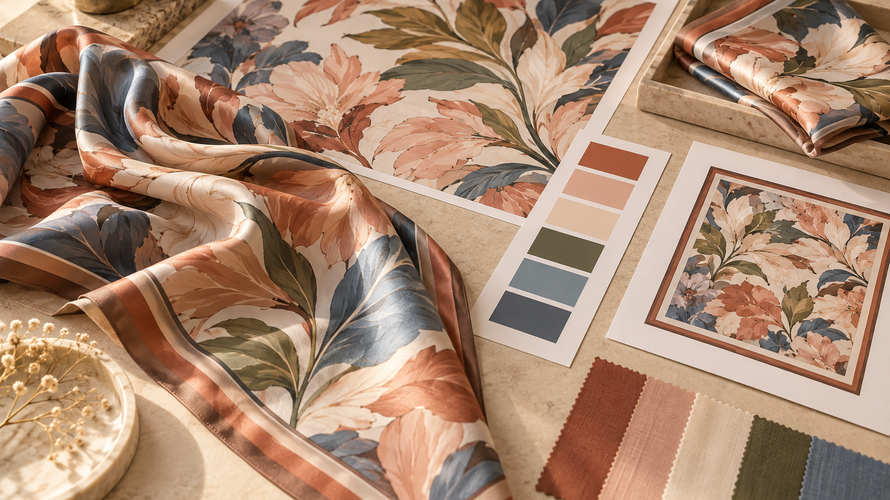
State substrate composition, construction, weight, width, usable width, artwork file, repeat, colour references, print direction, heat settings, finishing, care and test requirements.
For a custom scarf, also define dimensions, border or placement, surface pattern route, hem and packaging. Do not approve a transfer sheet as the final product.
Frequently Asked Questions
What is sublimation printing?
It is a heat-based dye transfer method in which suitable dye moves into a polyester or polymer-coated surface.
Can sublimation print on silk?
Standard dye sublimation is generally designed for polyester or compatible polymer surfaces. A silk project needs a different validated print route unless the supplier confirms a suitable system.
Is sublimation printing permanent?
It can provide strong wash performance when the substrate, dye and process are compatible, but the actual finished quality should be tested for the intended care and use.
Does sublimation printing leave a texture?
Because the dye enters the compatible polymer surface, it may not leave the same raised film as some surface-print methods. The base fabric hand still remains important.
What fabric is best for sublimation?
A suitable polyester-rich or polymer-coated fabric is a common starting point. Confirm fibre content, construction, colour and final hand with a sample.
Is sublimation better than digital textile printing?
Neither is universally better. Choose by fibre, artwork, hand, colour, quantity, care and finished-product requirements.
What should buyers approve before sublimation bulk production?
Approve the substrate, artwork, colour, repeat, heat response, wash or rub performance and a production-scale finished sample.
Conclusion
Sublimation printing is a heat-transfer dye process that works best when the substrate and polymer chemistry are compatible. Lock the fabric, artwork, colour, heat response and finishing requirements, then approve the real finished sample before bulk production.