
What Is Moisture-Wicking Fabric? Properties, Testing and Buyer Checks

Carina Silk Editorial Team writes practical guides on silk fabrics, scarves and custom textile development, with a focus on materials, artwork, sampling, construction and finishing decisions.

Moisture-wicking fabric is designed or selected to move liquid moisture across or through a textile so it can spread, evaporate or be managed away from a particular surface. Wicking is about liquid transport; it is not automatically the same as absorbency, breathability, cooling or quick drying.
The result depends on fibre, yarn, capillary spaces, knit or weave, surface finish, layers and surrounding airflow. The synthetic-fabric guide and fabric weight guide provide useful context, but a performance claim needs a defined test on the finished quality.
What Is Moisture-Wicking Fabric?
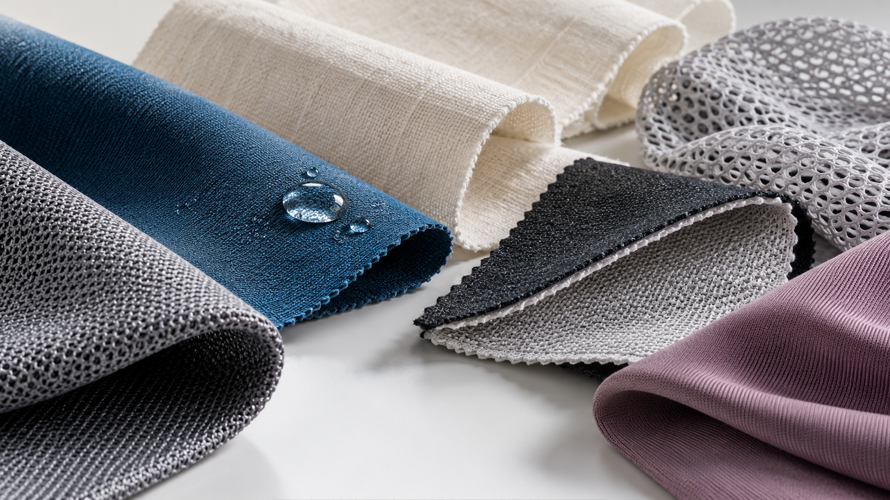
Moisture-wicking fabric encourages liquid to move from one area to another through capillary action and fabric structure. The textile may spread moisture over a larger surface, move it to an outer layer or support evaporation when conditions allow.
A fabric can absorb liquid without moving it efficiently, and a fabric can move moisture without holding a large amount of it. Breathability also depends on air and vapour transport, construction, garment design and environmental conditions.
Wicking may be built into the fibre and structure or supported by a finish. Finishes can change after repeated washing, so the claim should be tied to the tested care life and the intended product construction.

How Does Moisture Wicking Work?
Liquid contacts the textile surface, wets the yarn or fibre, and moves through available capillary paths. Fibre surface energy, yarn size, spacing, knit or weave and finish all influence the rate and direction of movement.
A two-sided or layered fabric may be designed to move liquid from an inner surface toward an outer surface. The garment or product then needs enough exposed area and airflow for drying to occur.
A lab test can describe spreading or drying under specific conditions, but it should not be translated into an unlimited comfort or health promise. State the test, product construction and care limits.
What Are the Main Moisture-Wicking Fabric Directions?
Classify the performance system by fibre, structure and finish rather than by a marketing adjective alone.
| Direction | How moisture may be managed | Potential fit | What to confirm |
|---|---|---|---|
| Engineered synthetic knit | Capillary channels and fast spreading | Activewear and performance layers | Wetting, spread and drying |
| Hydrophilic-treated fabric | Finish improves surface wetting or transport | Technical or active products | Wash durability of finish |
| Cotton or cellulose textile | Absorbs and may spread liquid through structure | Casual and comfort products | Drying time and wet weight |
| Double-layer construction | Moves liquid from one face to another | Next-to-skin systems | Layer direction and seam design |
| Mesh or open construction | Increases airflow and exposed area | Warm-weather products | Coverage, snag and opacity |
| Blend with elastane | Combines transport with stretch and recovery | Close-fitting products | Blend, recovery and care |
Wicking vs Absorbency vs Breathability: What Is the Difference?
Absorbency describes how much liquid a material can take up. Wicking describes how liquid moves through or across the material. Breathability commonly refers to air or water-vapour transmission through the textile system. A product can perform differently on each measure.
Construction matters as much as fibre. Compare the finished quality with the woven fabric guide or a knit specification, and record weight, density, finish, layers and seam placement.
For buyer communication, use only the performance terms supported by the test. Avoid promising a dry, cool or comfortable experience in every climate based on one wicking result.
What Should Buyers Check in Moisture-Wicking Fabric?
A credible wicking specification connects the test method to the exact textile, construction, care route and intended use.
Performance Definition
State whether the requirement is wetting, spreading, one-way transport, drying, absorbency or vapour transmission.
Fibre and Construction
Record fibre, yarn, knit or weave, density, weight, layers and any mesh or channel structure.
Finish and Durability
Identify any wicking finish and test whether performance remains after the agreed wash or care cycles.
Test Conditions
Record liquid, temperature, humidity, contact method, time, orientation and measurement because results depend on conditions.
Finished Product
Inspect seams, coatings, prints, linings and fit because the garment or accessory can change moisture movement.
Claims and Care
Match marketing and care language to the verified result and state limitations where necessary.
| Check | Why it matters | Possible risk | Evidence to request |
|---|---|---|---|
| Claim definition | Prevents vague performance language | Wicking confused with absorbency | Test requirement |
| Construction | Controls capillary paths | Fabric works differently in product | Technical specification |
| Finish | Controls durability | Performance drops after washing | Wash-cycle test |
| Conditions | Makes results comparable | Unrepeatable result | Test report |
| Product assembly | Controls real use | Seams or lining block transport | Finished prototype |
| Care wording | Protects claim accuracy | Customer expectation mismatch | Approved label copy |

Where Is Moisture-Wicking Fabric Used?
Moisture-management fabrics are used in activewear, base layers, uniforms, socks, performance accessories and some warm-weather products. The right construction depends on contact, movement, climate, coverage and the drying environment.
For a scarf or head-covering product, wicking is only one variable. Compare it with head-scarf fabric options and modal fabric for grip, opacity, drape, comfort, care and edge finish.
Use performance language conservatively and retain the test record behind any product claim.

How Should Moisture-Wicking Fabric Be Specified?
State fibre and blend, construction, weight, width, finish, layer direction, required wetting or transport measure, test conditions, wash durability, care, product assembly and claim wording.
Attach a fabric swatch, test report and finished prototype. The performance should be verified on the exact quality and after any print, coating, lining or finishing step that forms part of the product.
Frequently Asked Questions
What is moisture-wicking fabric?
It is fabric designed or selected to move liquid moisture across or through the textile so it can spread, evaporate or be managed away from a surface.
Is moisture-wicking fabric the same as breathable fabric?
No. Wicking concerns liquid transport, while breathability commonly concerns air or water-vapour transmission. A textile can perform differently on each property.
Does moisture-wicking fabric absorb water?
Some wicking fabrics absorb or wet at the surface, while others move liquid with limited holding. Absorbency and wicking should be tested separately.
What fibres are moisture-wicking?
Many fibres and blends can be engineered for moisture management. Fibre, yarn, construction and finish all matter, so no single fibre guarantees performance.
Does wicking fabric dry quickly?
It may support faster drying by spreading liquid over more area, but drying also depends on weight, structure, airflow, humidity and product design.
Do wicking finishes wash out?
Some finishes can change with repeated washing. Test the agreed care life and state the result accurately.
What should a buyer request?
Request a defined performance requirement, fibre and construction data, test conditions, wash durability, care limits and a finished product sample.
Conclusion
Moisture-wicking is a measurable transport behaviour, not a universal synonym for breathable, absorbent or quick-dry. Define the claim, test the exact construction and care route, and verify the finished product before using the term commercially.
