Does Polyester Shrink? Heat, Blends, Care and Buyer Checks

Carina Silk Editorial Team writes practical guides on silk fabrics, scarves and custom textile development, with a focus on materials, artwork, sampling, construction and finishing decisions.
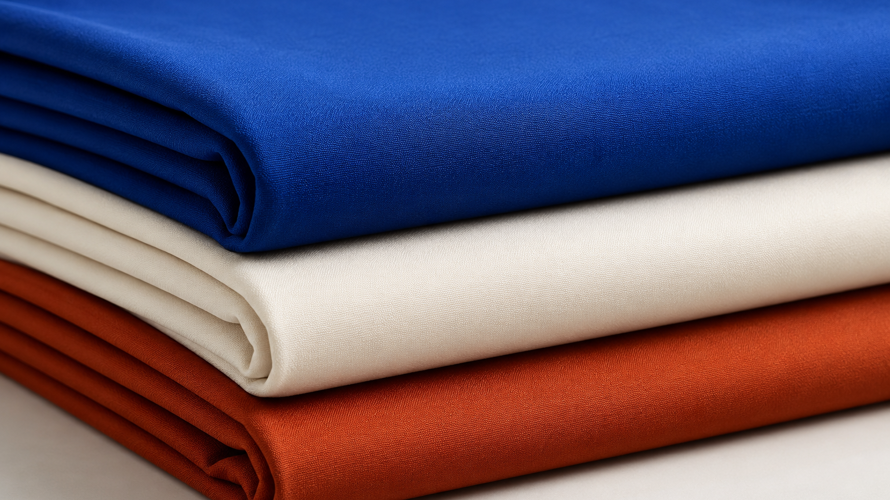
Pure polyester often resists ordinary washing shrinkage better than many natural fibres, but it is not correct to treat every polyester fabric as dimensionally unchanged. Whirlpool’s polyester care guidance notes that high heat and blends can change the result. Yarn, construction, finishing and drying conditions still matter.
For B2B sourcing, the practical question is whether the finished product stays within its agreed length, width, skew and print-placement tolerance after the intended care route.
Can Polyester Shrink?
Shrinkage or relaxation can occur through heat, wet processing, tension release or a blend component that behaves differently from polyester. A polyester satin, knit, fleece and plain weave can respond differently even when the fibre name is identical.
Compare the quality with the polyester fabric guide and record the actual weave, knit, weight and finish. “Easy care” is not a dimensional test.
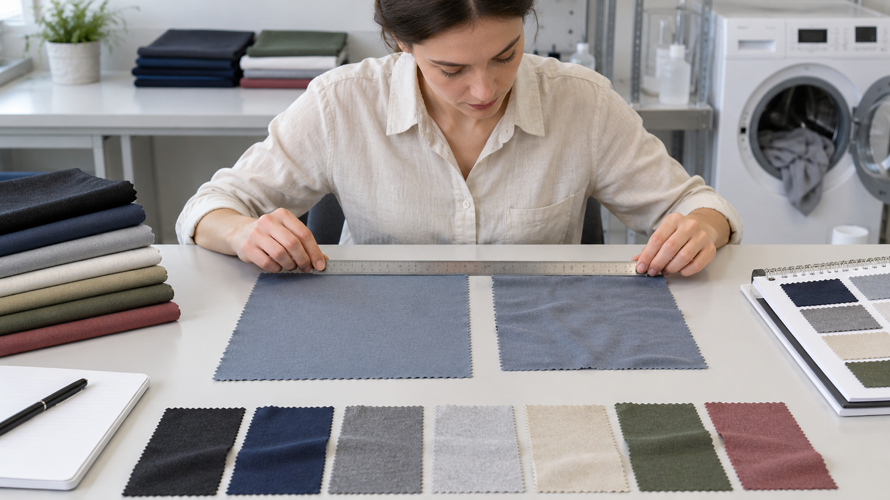
Use a fabric swatch marked in both directions, then measure before and after washing, drying and pressing under the agreed conditions.
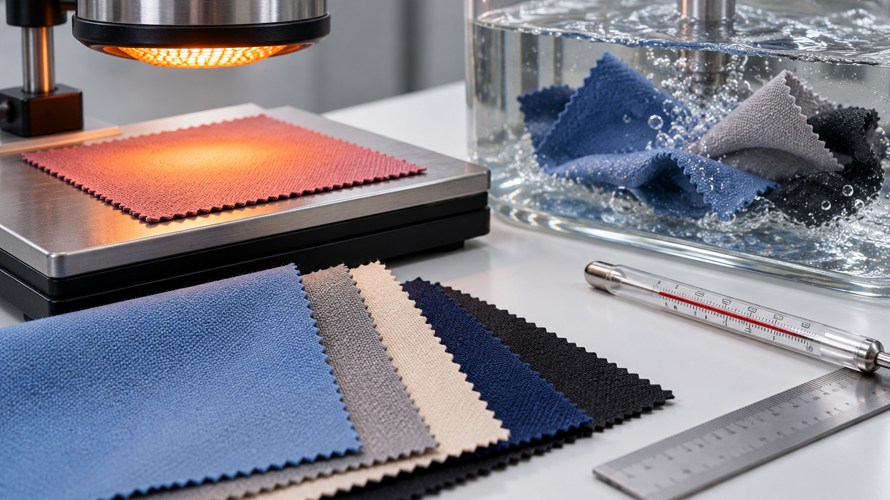
Why Does Polyester Change Dimension?
Polyester yarn is formed as filament or staple fibre and then woven or knitted. Heat-setting, texturing, brushing, coating and other finishing steps establish tensions and surface properties.
High heat, unsuitable pressing, blend behaviour or residual relaxation can change length, width, surface or recovery. The result may be shrinkage, growth, skew or a change in hand rather than one simple percentage.
For printed goods, place the dimensional test next to the artwork and hem review. A finished sample can show whether the change affects the customer-facing product.
Which Polyester Qualities Need Different Shrinkage Checks?
Use the construction and heat history to determine the right test.
| Direction | Textile character | Potential fit | What to confirm |
|---|---|---|---|
| Filament polyester | Continuous yarn with smooth or textured surface | Scarves, linings and polished products | Heat, lustre and width |
| Spun polyester | Staple-fibre yarn with fuller hand | Matte apparel and practical cloth | Blend, pilling and shrinkage |
| Polyester knit | Looped construction with recovery | Apparel and stretch products | Knit relaxation and recovery |
| Polyester satin | Smooth reflective face | Formal accessories and linings | Heat, slip and surface change |
| Recycled polyester | Polyester with a stated recycled input | Claim-led products | Composition and claim evidence |
| Polyester blend | Polyester combined with another fibre | Products needing altered hand or care | Blend ratio and dimensional result |
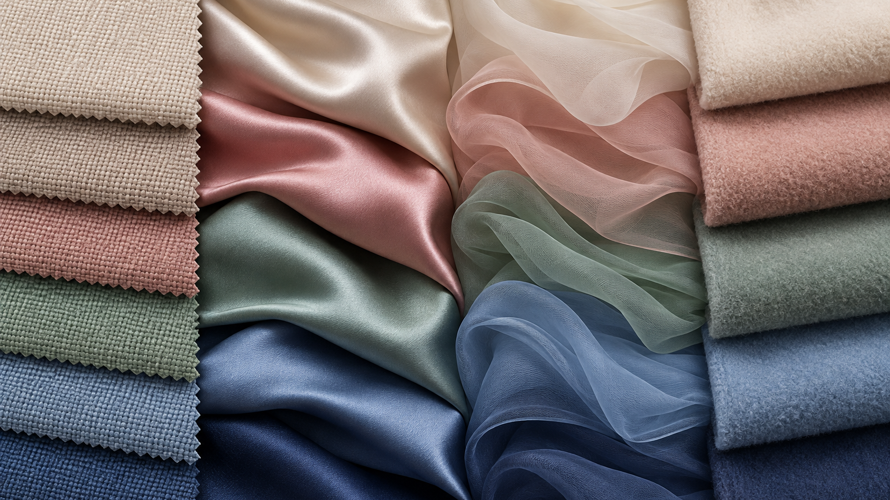
Polyester Shrinkage vs Polyester Growth: What Should You Measure?
A fabric can become shorter or narrower, but it can also relax, skew, stretch or change after pressing. Measuring only length can miss a quality problem.
Compare polyester with rayon or cotton using the same sample size, care route and measuring points. Different fibres can move differently inside a blend or finish.
Record length, width, diagonal, GSM, surface and print placement before and after the test. Define an acceptance range before bulk production.
What Should Buyers Check in Polyester Shrinkage?
Treat dimensional stability as a finished-quality test.
Composition and blend
Confirm polyester percentage and any fibre that may change wet or heat behaviour.
Heat history
Record heat-setting, coating, pressing and finishing conditions that establish fabric tension.
Care route
Use the actual washing, drying, pressing and agitation instructions for the finished product.
Dimensional points
Measure length, width, diagonal, skew and any engineered border or repeat.
Surface and colour
Check lustre, hand, print, colourfastness, pilling and finish after the trial.
Finished sample
Review the cut, hem, seam, packaging and wearing result before bulk approval.
| Check | Why it matters | Possible risk | Evidence to request |
|---|---|---|---|
| Blend | Controls dimensional behaviour | Component mismatch | Composition statement |
| Heat | Controls residual tension | Press or dryer damage | Process record |
| Care | Makes result repeatable | Household route differs | Care trial |
| Dimensions | Controls yield and fit | Border or size shifts | Before-after measurements |
| Surface | Controls appearance | Shine or finish loss | Finished swatch |
| Product | Confirms actual use | Roll test misleads | Approved sample |
Where Does Polyester Shrinkage Matter?
Dimensional control matters in scarves, apparel, linings, sportswear, fleece, uniforms, home textiles and printed panels. The correct tolerance depends on the finished product and care expectation.
For a printed scarf, compare polyester with silk satin or twill by print definition, heat response, grip, drape, opacity and finished dimensions.
If a product will be washed, steamed, pressed or heat-finished, test that route before setting cutting and packaging specifications.

How Should Polyester Shrinkage Be Specified?
State polyester and blend content, yarn form, construction, GSM, width, finish, care route, measuring method, dimensional tolerance and print or border allowance. Use the GSM guide for comparable weight records.
Attach a marked swatch, before-and-after measurements and a finished sample. Do not approve “low shrinkage” without defining the test conditions.
Frequently Asked Questions
Does polyester shrink?
Pure polyester often resists ordinary shrinkage, but heat, blends, finishing and construction can still change dimensions or surface.
Does polyester shrink in a dryer?
High heat can change some polyester qualities and blends. Follow the tested care route and supplier instructions.
Does 100% polyester shrink?
It may be more stable than many natural fibres, but the exact result still depends on yarn, construction, finishing and heat exposure.
How do you test polyester shrinkage?
Mark length and width points, measure the sample, apply the agreed wash and dry route, then measure dimensions, skew, surface and print placement again.
Is polyester good for scarves?
It can be suitable when hand, drape, print, colour, care and dimensional stability meet the brief.
Does polyester stretch or grow?
Some qualities can relax or stretch instead of shrinking. Measure both directions and diagonal rather than assuming one movement.
What should a polyester buyer request?
Request composition, construction, heat and care records, dimensional test results, print evidence and an approved finished sample.
Conclusion
Polyester shrinkage is a property of the exact fabric and heat-care route. Control composition, construction, finishing, measuring points, tolerance and the finished sample before production.