
What Is Paisley? Pattern Meaning, Textile Uses and Buyer Checks

Carina Silk Editorial Team writes practical guides on silk fabrics, scarves and custom textile development, with a focus on materials, artwork, sampling, construction and finishing decisions.

Paisley is a decorative motif, not a fibre, weave or one manufacturing process. It is commonly recognized by a curved teardrop, leaf, cone or buta-like form, often combined with florals, curls and a directional repeat. A paisley product may be printed, woven, jacquard-made or embroidered on many different bases.
For a buyer, the useful question is not simply whether a fabric is “paisley”. Confirm the base fibre, construction, artwork repeat, scale, direction, border, colour target and finished dimensions. The fabric-pattern guide and the printed, woven and jacquard comparison help separate the visual motif from how it reaches the cloth.
What Is Paisley?
Paisley describes a recurring ornamental motif with a curved, often asymmetrical form. Museum collections connect the western name with the town of Paisley, Scotland, which became a major centre for producing shawl imitations; the Paisley Museum textile collection documents the town’s shawls, pattern books and production technology.
The motif has a broader history than its English name. The Metropolitan Museum of Art shawl record describes the form as an ancient Persian design associated with tree-of-life, bud, cone and palm-frond imagery. Use historical language carefully: the current commercial pattern is the result of multiple textile traditions, adaptations and manufacturing routes.
Paisley can be a surface artwork on a silk fabric, a woven structure, a jacquard motif or an embroidered decoration. The name alone does not establish fibre content, construction, print quality, origin or cultural meaning.
How Is Paisley Put on Fabric?
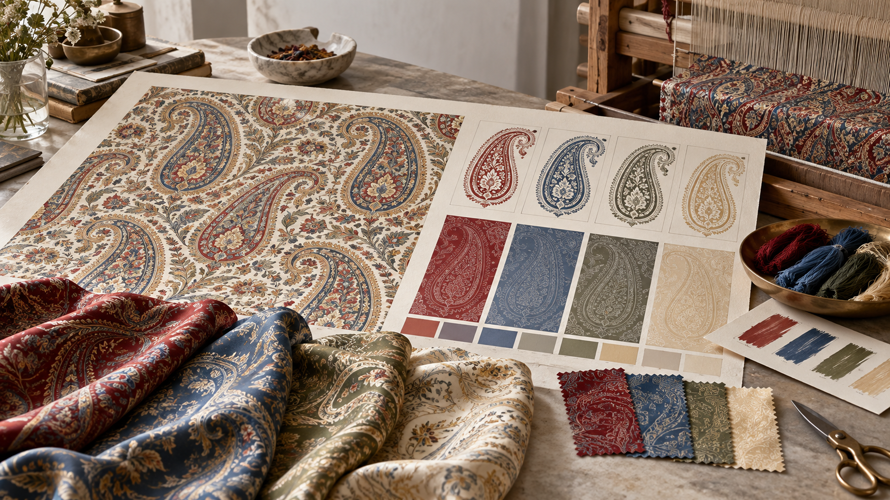
A designer first defines the boteh or related motif, then builds a repeat that controls scale, spacing, direction and colour. The repeat may be arranged as an all-over print, border, panel, stripe or engineered placement.
The artwork can be printed onto a prepared fabric, formed in the weave through yarn or jacquard control, or added with embroidery or other surface techniques. Each route changes registration, reverse-side appearance, colour depth, hand and cost.
For a custom scarf, review the artwork on the actual base. A swatch workflow should include a strike-off or woven reference with the planned scarf size, border and finished hem, not only a flat screen proof.
What Are the Main Paisley Textile Directions?
The same motif can create very different products because the base construction and decoration route change its hand and performance.
| Direction | How the motif appears | Potential fit | What to confirm |
|---|---|---|---|
| Printed paisley | Artwork is applied to the fabric surface | Scarves, apparel and home textiles | Registration, colour and wash response |
| Woven paisley | Motif is created through yarn interlacement | Structured textiles and durable accessories | Reverse, repeat and construction |
| Jacquard paisley | Figure and ground are controlled by loom lifting | Patterned premium fabrics | Float length, snag risk and scale |
| Embroidered paisley | Thread is added above the base cloth | Decorative products and limited runs | Density, backing and abrasion |
| Border paisley | Motif is engineered to an edge or panel | Scarves, shawls and trims | Placement, hem allowance and direction |
| Mini or large-scale paisley | Scale changes visual density and cutting yield | Different product styles | Repeat, artwork size and proportion |
Paisley Pattern vs Paisley Fabric: What Is the Difference?
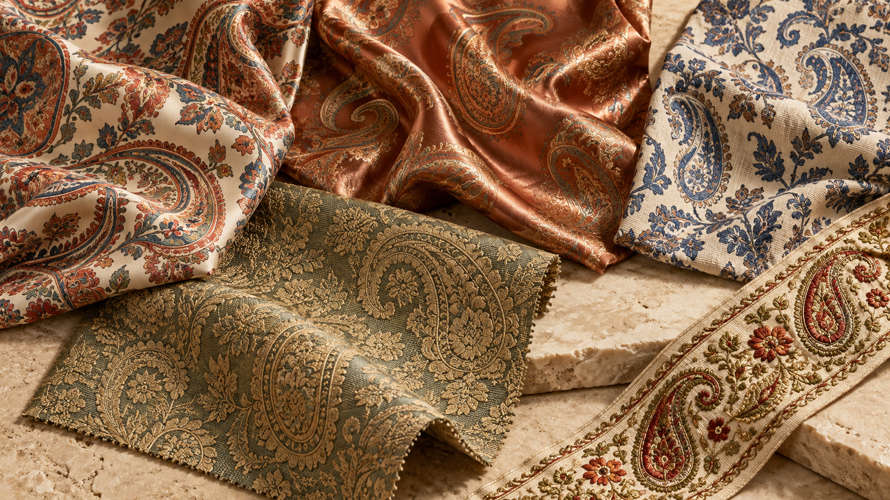
A paisley pattern identifies the visual motif. Paisley fabric is a finished textile carrying that motif, but it still needs a fibre, construction, weight, width and finishing description. “Silk paisley”, for example, combines a fibre direction with an artwork direction; it does not specify whether the silk is twill, satin, chiffon or another construction.
Print route matters. A printed motif may have a different reverse, handle and abrasion response from a jacquard motif. Compare the result with the twill guide or satin guide when the base construction is part of the brief.
Paisley also interacts with cutting. Directional boteh, border layouts and large repeats can create placement waste or visible orientation differences. Record the finished layout in the printed-versus-woven comparison rather than approving the motif in isolation.
What Should Buyers Check in Paisley Fabric?
A paisley approval should protect both the artwork and the textile performance. Define the visual reference before the production route is locked.
Motif and History
Name the intended motif direction and avoid using a decorative name as evidence of fibre, origin, certification or cultural meaning.
Repeat and Scale
State repeat width, height, motif scale and acceptable variation so the printed or woven layout can be checked objectively.
Direction and Border
Confirm whether the boteh has a fixed direction, whether a border is engineered and how the motif meets the hem or selvedge.
Colour and Registration
Approve a colour target and inspect registration, fine outlines, dark-ground coverage and any show-through on the finished base.
Base Construction
Record fibre, yarn, weave or knit, weight, width, opacity, finish and the decoration route used to create the paisley.
Finished Sample
Review the full-size scarf or product after printing, washing, pressing and hemming because scale and edge placement can change in production.
| Check | Why it matters | Possible risk | Evidence to request |
|---|---|---|---|
| Artwork repeat | Controls scale and yield | Motif is cropped or misaligned | Approved repeat tile |
| Direction | Controls cutting and styling | Boteh faces inconsistent ways | Layout drawing |
| Colour | Controls brand and lot consistency | Ground or accent shifts | Strike-off and colour target |
| Base cloth | Controls hand and performance | Visual match but wrong fabric | Composition and construction |
| Decoration route | Controls reverse and durability | Print confused with weave | Production description |
| Finished product | Confirms final appearance | Sample does not represent bulk | Approved finished reference |
Where Is Paisley Used?
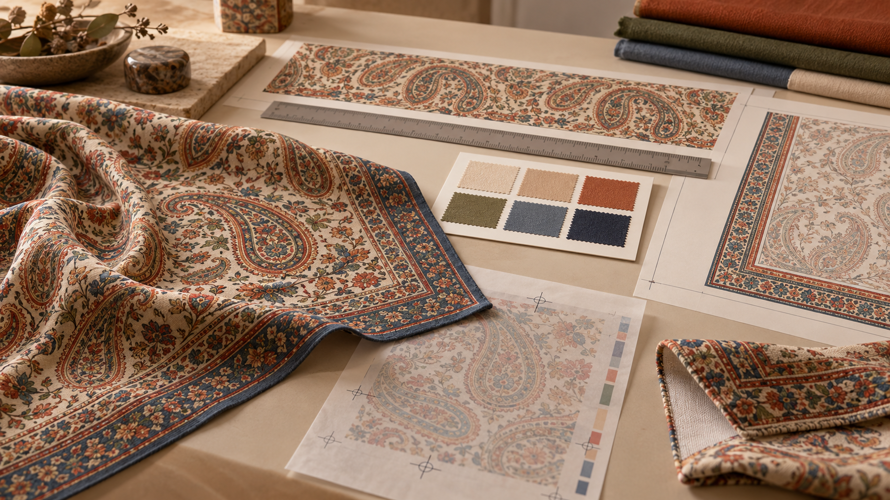
Paisley is used on scarves, shawls, ties, shirts, dresses, furnishing textiles, bandanas and accessories. Its visual density can range from a small repeating all-over design to a large engineered border or central panel.
For luxury printed scarves, pair the motif with an appropriate silk fabric direction and confirm whether the intended hand comes from twill, satin or another base. For a more casual product, a cotton or synthetic base may be selected for care, cost or durability reasons.
Choose the motif because it supports the product brief, not because the name implies a particular material or quality level.
How Should Paisley Fabric Be Specified?
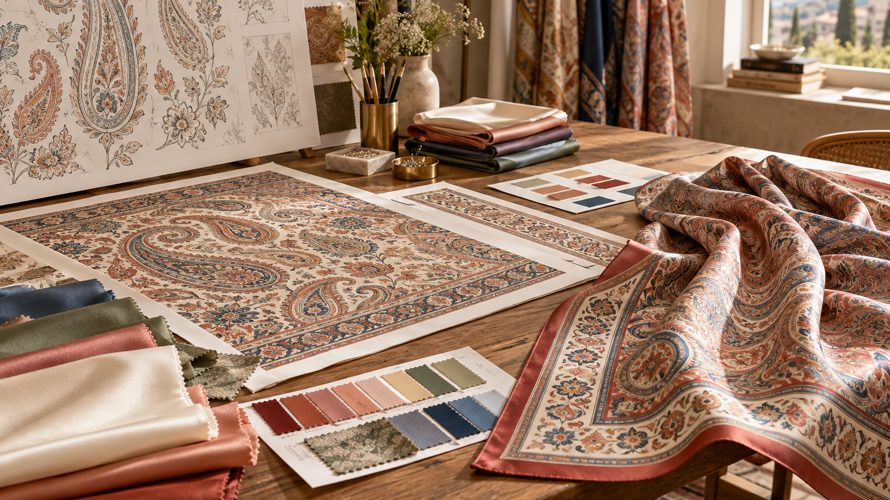
State the motif reference, repeat dimensions, scale, direction, border or panel layout, colour targets, ground and accent colours, fibre, construction, weight, width, decoration route, print side, opacity, edge and care.
Attach the approved artwork and a finished fabric swatch. For a scarf, include the actual dimensions and hem so the buyer can assess crop, orientation, registration and the relationship between the paisley repeat and the final product.
Frequently Asked Questions
What is paisley?
Paisley is a decorative textile motif commonly recognized by a curved teardrop, leaf, cone or buta-like form. It is a design direction, not a fibre or weave.
Is paisley a type of fabric?
No. Paisley describes the motif on a fabric. The fabric may be silk, cotton, viscose, polyester, wool or a blend, and it may be printed, woven or embroidered.
Is paisley always printed?
No. Paisley can be printed, woven, jacquard-made, embroidered or otherwise applied to a textile surface. Confirm the production route.
Is paisley the same as a floral print?
Not exactly. Paisley may include floral and botanical details, but its characteristic curved boteh-like form gives the pattern its identity.
What fabric is best for a paisley scarf?
There is no universal best fabric. Compare the required hand, drape, opacity, print route, scale, care and finished edge on the intended sample.
Does paisley have a specific cultural origin?
The motif has a complex history across Persian, Indian, Kashmiri, European and other textile traditions. Describe the specific reference rather than making a simple single-origin claim.
What should a buyer check before ordering paisley fabric?
Check motif repeat, direction, scale, colour, registration, base fibre and construction, decoration route, width, border placement and a finished product sample.
Conclusion
Paisley is best treated as an artwork and repeat specification, not as a material name. Separate motif from fibre, construction and decoration route, then approve the exact repeat, colour, base cloth and finished scarf before bulk production.
